

Twisted Gorilla vs Fresh Air Shirts: Custom Airbrush Guide
Table of Contents
- Twisted Gorilla vs Fresh Air Shirts: What Each Brand Does
- Custom Airbrush T-Shirts vs Graphic Tees: How the Methods Differ
- How to Care for Airbrushed Clothing So the Design Lasts
- Unisex Fit, Fabric, and Sizing Across Custom Airbrush Shops
- Bulk Orders vs Single Custom Pieces for Concerts and Events
- Ordering Custom Apparel Online: What to Check Before You Buy
- Conclusion
- Frequently Asked Questions
Last Updated: September 16, 2026
Twisted Gorilla vs Fresh Air Shirts: What Each Brand Does
If you've ever stood in a mall watching an artist spray-paint a name onto a shirt while you wait, you already understand the appeal of custom airbrush. This guide from Hot Takes Designs breaks down how mall-style airbrush studios and event-day airbrush kiosks actually work, where they fall short, and how to decide whether a custom airbrush piece or a printed graphic tee is the better call for your next concert, trip, or fan event.

Custom Airbrush T-Shirts vs Graphic Tees: How the Methods Differ
Custom airbrush is a by-hand application technique where an artist uses a small spray gun to lay pigment directly onto fabric, usually over a stencil or freehand. Graphic tees are printed using a mechanical process like screen printing, direct-to-garment (DTG), direct-to-film (DTF), or sublimation, where the design is transferred to the garment through heat, pressure, or ink bonding.
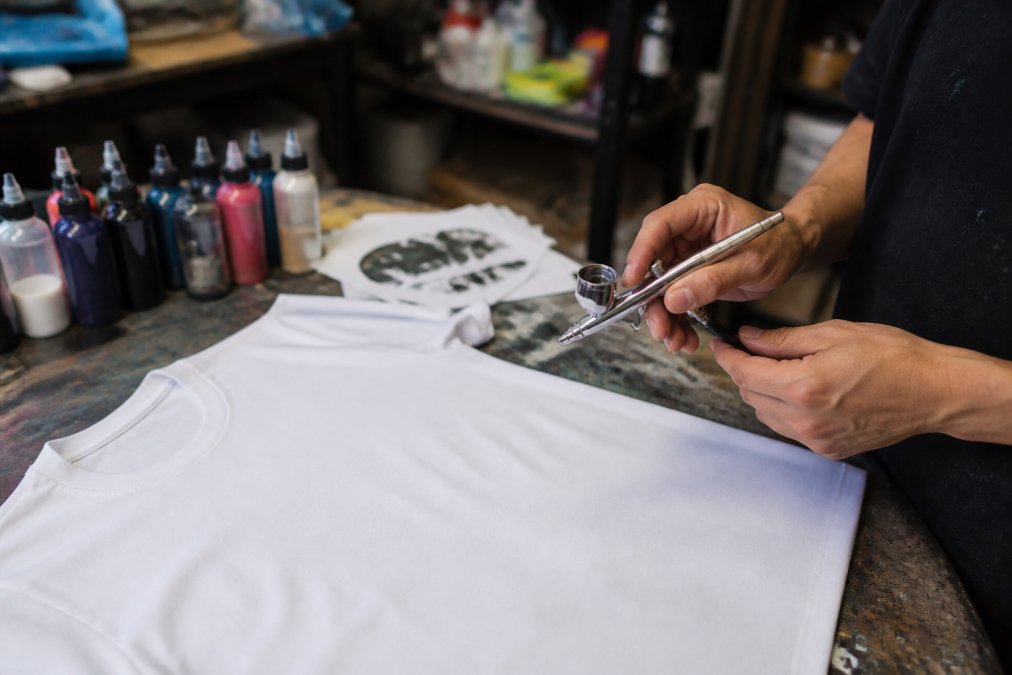
Print methods side by side: airbrush, screen printing, DTG, DTF, and sublimation
| Method | How It Works | Durability | Color Range | Best For |
|---|---|---|---|---|
| Airbrush | Artist sprays pigment by hand over stencil or freehand | Varies widely; can fade with washing | Unlimited blends, soft gradients | One-off pieces, names, event-day personalization |
| Screen printing | Ink pushed through a mesh screen, one screen per color | Very durable; outlasts the garment when cured properly | Limited, each color needs its own screen | Bulk runs, bold spot-color graphics, team and tour merch |
| DTG (Direct-to-Garment) | Inkjet-style printer deposits ink directly onto the shirt | Good on 100% cotton; can fade on blends | Full color, but less vivid on dark shirts | Small-batch full-color designs, photo prints |
| DTF (Direct-to-Film) | Design printed to film, heat-pressed onto garment | Strong bond; resists cracking when cared for | Full color on any fabric color | Bold graphics, caps, small-batch runs |
| Sublimation | Ink bonded into fabric fibers under heat | Won't crack or peel; fades only if fabric does | Full color, but only on light or polyester | All-over prints, mesh, polyester blends |
What actually separates these methods
Upfront cost scales with quantity, but not the way most people assume. Screen printing carries a setup cost per color because each screen must be burned before the first shirt prints. That setup is why screen printing is the cheapest per-piece option at volume and one of the most expensive for a single shirt. DTG and DTF skip the screens entirely, so they stay economical at low quantities but lose their edge once you cross into true bulk territory.
Why the method matters less than the finish
A poorly cured screen print cracks. A poorly cured DTF transfer peels. A poorly sealed airbrush piece washes out. The method sets the ceiling on durability; the shop's finishing process determines whether you actually reach it. When you compare two custom apparel options, ask what the shop does after the ink goes down, proper heat curing, a quality blank, and correct handling matter more than the label on the process.
How to Care for Airbrushed Clothing So the Design Lasts
Airbrushed designs last longest when you wash them cold, inside out, and skip the dryer. Heat is the enemy: hot water and high dryer settings break down hand-sprayed pigment faster than anything else. But the care routine that actually preserves an airbrush piece starts before the first wash, with how the artist finished it and how you store it.
The step most buyers skip: curing and heat-setting
Airbrush pigment needs time and heat to set. A responsible artist either heat-sets the piece (often with a heat press or a carefully controlled iron over a pressing cloth) or lets it air-cure for a period before the shirt is worn or washed. If you buy an airbrushed piece at a festival or kiosk, ask whether it has been heat-set and how long it should cure before the first wash.
The wash routine that actually works
A few rules that matter more than any detergent brand:
- Turn the garment inside out before every wash
- Use cold water and a gentle or delicate cycle
- Wash airbrushed pieces separately from heavy items like jeans or towels that abrade the surface
- Skip bleach and fabric softener entirely, softener leaves a residue that can lift pigment
- Tumble dry low or hang dry; high heat is what cracks and fades designs
- Never iron directly over the design; if you must press the shirt, iron the reverse side over a pressing cloth
Storage and long-term preservation
How you store a hand-painted piece matters as much as how you wash it. Fold airbrushed shirts rather than hanging them on wire hangers for long periods, since the shoulder line can crease the pigment. Keep them out of direct sunlight when stored, UV exposure fades airbrush pigment the same way it fades upholstery. For a memorial piece or a one-of-a-kind you want to keep for years, a breathable garment bag beats a sealed plastic one, which can trap moisture.
How this compares to caring for printed pieces
Printed pieces, screen print, DTG, DTF, and sublimation, follow almost the same routine, and it is worth following closely. Cold water, inside out, low heat, no softener. The main difference is margin for error: a properly cured screen print or sublimation piece tolerates a warm wash and a low dryer cycle far better than an airbrushed one. Our own made-to-order tees, for example, are built with fade-proof graphics and pre-shrunk fabric, so turning them inside out and washing cold keeps the graphic sharp cycle after cycle.
BTS ARMY World Tour Hooligan Unisex →
Unisex Fit, Fabric, and Sizing Across Custom Airbrush Shops
Sizing is where most custom apparel brands quietly let you down. A unisex tee that's "one size fits most" usually means it fits a medium body well and everyone else poorly.
Bulk Orders vs Single Custom Pieces for Concerts and Events
Bulk orders win on price per piece. Single custom pieces win on uniqueness and turnaround flexibility. Which one you need depends entirely on the event.
| Scenario | Better Choice | Why |
|---|---|---|
| Group of 5+ attending a concert | Bulk printed order | Consistent sizing, lower per-piece cost |
| Solo fan event or memorial | Single custom piece | Personal, unique, no minimum order |
| Vacation souvenir | Single airbrush piece | One-of-a-kind, location-specific |
| Tour merch for a small creator | Bulk printed order | Repeatable design, scalable as demand grows |
Ordering Custom Apparel Online: What to Check Before You Buy
Ordering custom apparel online comes down to four checks: fabric spec, print method, size grading, and turnaround time. Get those four right and you'll rarely be disappointed.
Conclusion
Choosing between a mall-style airbrush studio, an event-day kiosk, or a made-to-order print shop comes down to what you actually need: a one-of-a-kind piece, or a durable graphic tee you'll wear for years. For fans who want bold designs that survive the wash cycle, Hot Takes Designs makes custom-printed apparel on ultra-soft fabrics with vibrant, long-lasting prints, in inclusive sizing from 2XS to 6XL.
Frequently Asked Questions
How long does airbrushing actually last on a shirt?
Airbrushed designs sit on the surface of the fabric, so longevity depends on paint type, heat setting, and washing habits. Most airbrush shops heat-set their paint, which helps it bond to the cotton. With cold washing and air drying, a well-applied design can hold up for years. Skip hot water, bleach, and high dryer heat, since those break down the paint film faster than anything else.
Are airbrushed shirts machine washable?
Most are, with conditions. Turn the garment inside out, use cold water on a gentle cycle, and keep it away from bleach and fabric softener. Tumble dry low or hang dry. The same rules apply to how to care for airbrushed clothing from any shop, whether you buy a custom airbrush t-shirt from a mall kiosk or order one online. Hand washing is the safest option for heavily painted pieces.
How do I choose between custom airbrush designs and standard graphic tees?
Pick airbrush when you want a one-of-a-kind piece, a name or number added on the spot, or a design that does not exist as a printed graphic. Pick a printed graphic tee when you need exact color matching, a large run of identical shirts, or a lower price per unit. For concert fits and fan events, many buyers mix both: a printed base layer plus one airbrushed statement piece.
Do airbrush shops offer bulk ordering for events?
It depends on the shop. Mall kiosks and festival airbrush stands usually handle single pieces because each shirt is painted by hand. Online made-to-order shops can produce larger runs, but expect longer lead times since every item is printed or sewn after you order. If you need 20 or more shirts for a tour date or fan meetup, ask about turnaround before you commit, and order at least three to four weeks ahead.
What should I check before ordering custom apparel online?
Look at the fabric weight and fiber content, the print method, the size chart, and the return policy. A 100% combed ring-spun cotton tee at 4.2 oz/yd² feels different from a stiff 5.3 oz basic, and that difference matters when you are standing in a stadium line for hours. Check whether the shop grades its patterns for extended sizes or just scales up a smaller cut, and confirm how long made-to-order production takes.