

Managing Apparel Inventory for Fan Events, Step by Step
Last Updated: November 9, 2026
Quick Summary
Managing apparel inventory for fan events means forecasting demand from attendance and event type, planning a size curve that covers the full range, and tracking every sale in a shared sheet. Count stock live during the show, then reconcile leftovers within days. Plan for early sellouts and never bring your entire inventory to every show.
- Estimate how many fans will buy merch, not just venue capacity, and use past sales data first.
- Start with a size curve such as 25% XS to S, 40% M to L, 25% XL to 2XL, and 10% 3XL to 6XL.
- Track each SKU in a spreadsheet with units received, sold, and remaining, updated at every event.
- Count stock at doors open, end of the opening act, headliner set break, and close.
- Sort leftover stock within 48 hours into carryover, online sale, markdown, donation, or write-off.
Table of Contents
- Why Fan Event Apparel Inventory Is Different From Regular Retail
- Forecasting Demand Using Attendance, Audience and Event Type
- Building an Event Merchandise Inventory Plan With Size Curves
- Setting Up a Clothing Inventory Tracking Spreadsheet
- Running Live Stock Counts and Sales at the Event
- Planning for Event-Day Uncertainty and Contingency Stock
- Handling Leftover Event Merchandise After the Show
- Booking Your Next Fan Event Stock Plan
- Frequently Asked Questions
Why Fan Event Apparel Inventory Is Different From Regular Retail
Fan event merch sells fast, then stops cold.
At Hot Takes Designs, we sell edgy, custom-printed tees for K-Pop concerts and BookTok fandoms, so we know how quickly a sold-out size can turn into a missed sale.
Watch out: a size run that looks balanced on paper can leave you short on the sizes fans actually grab, especially 2XL and up.
Forecasting Demand Using Attendance, Audience and Event Type
Start with the number of people who will walk through the gate. Venue capacity and ticket counts are your ceiling, not your forecast.
Different events pull different buyers:
- Stadium tours: Large crowds, lots of casual buyers, strong demand for basic and oversized fits
- Club shows and fan meets: Smaller, more dedicated crowds who often buy more per person
- Festivals: Mixed audiences, so keep a broader assortment on hand
Use your own past sales data first. If you have none, a conservative estimate beats a guess. Plan a core stock you can always sell and a smaller set of extras you can restock or sell later.
Building an Event Merchandise Inventory Plan With Size Curves
A size curve is the share of each size you expect to sell. Most fan crowds skew toward the middle sizes, but inclusive sizing matters. Plan for the full range, from 2XS to 6XL, so no fan leaves disappointed.
Here is a simple starting curve to adjust with your own data:
| Size Group | Starting Share of Stock | Notes |
|---|---|---|
| XS to S | 25% | Often sells fast with younger buyers |
| M to L | 40% | Usually the top sellers |
| XL to 2XL | 25% | Keep enough for fans who want an oversized fit |
| 3XL to 6XL | 10% | Small share, but never zero |
Adjust the curve after every event. Track which sizes sold out first and which sat untouched. Your next plan gets sharper with each show.
Setting Up a Clothing Inventory Tracking Spreadsheet
You do not need expensive software to start. A shared spreadsheet works well for one or two events. Create one row for every SKU, meaning each unique style, size, and color combination.
Columns to Include in Your Tracking Sheet
- SKU: A unique code for each product variant
- Style name and color
- Size
Keep the sheet in one shared file so every person on your team works from the same numbers.
Running Live Stock Counts and Sales at the Event
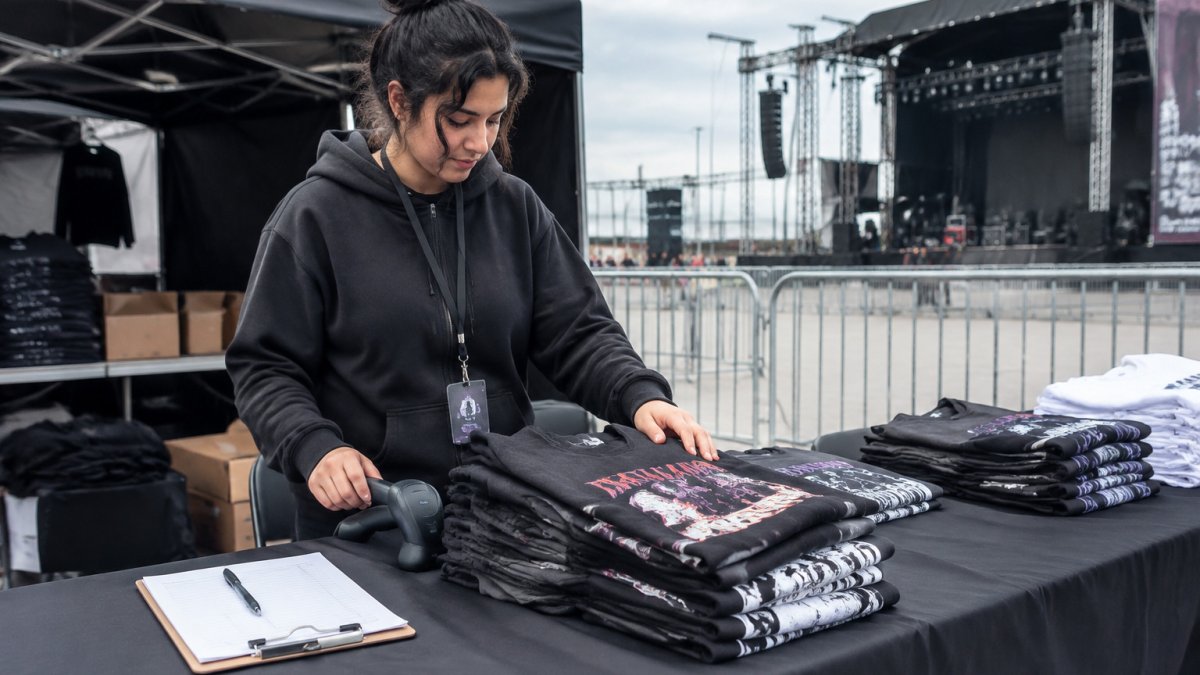
Live stock visibility during the event matters because it keeps you from selling a size you cannot hand over. The goal is simple: know what you have on the table, in backup boxes, and in transit between booths at any given moment, so you never sell a size you cannot hand over.
Set Up Point-of-Sale So Every Sale Updates Stock
Ring every sale through a point-of-sale (POS) system that decrements inventory by SKU at the moment of payment.
If you are running a cash box and tally sheets instead of a POS, print a grid with one row per style and one column per size, and have the cashier mark a tally for every unit sold. Reconcile the tally against the physical count at every set break.
Assign Booth Roles and a Restock Cadence
Split staff into three roles so no one is doing everything at once:
- Cashier: Rings sales and confirms the size is in hand before taking payment.
- Runner: Pulls replacement units from backup boxes and refills the table when a size drops below a set floor (for example, fewer than three units on display).
- Counter: Does a physical count of the table and backup boxes at scheduled checkpoints and updates the master sheet.
Tie the count cadence to the event schedule, not the clock. Count at doors open, at the end of the opening act, at the headliner's set break, and at close. Those checkpoints match the demand spikes, so you catch a sold-out size while there is still time to pull from backup or move stock from a second booth.
Move Stock Between Booths and Locations
If you run more than one booth or a booth plus a will-call table, treat transfers as inventory transactions, not favors. Log every transfer with the SKU, quantity, from-location, to-location, and time.
Watch out: a runner who grabs units from a backup box without logging them creates a count that looks fine on the table and wrong in the books, and you will not discover the gap until reconciliation after the show.
Keep a Live Stock Board Visible to Staff
Post a simple stock board, a whiteboard or a shared tablet, behind the booth showing units remaining by style and size. Update it at each checkpoint. Staff can then tell a fan "that size is gone at this booth but available at the second location" instead of losing the sale. If a size is truly out, capture the fan's contact for a pre-order or restock notification rather than letting them walk.
Reconcile at Close, Not the Next Day
At the end of the night, count every unit on the table, in backup boxes, and in transfer, then compare against the master sheet. Any variance larger than a couple of units per style usually points to an unlogged transfer, an offline sale that did not sync, or a damaged item pulled without a note. Reconcile before you pack, while the staff who worked the booth can still explain the gap.
Planning for Event-Day Uncertainty and Contingency Stock
Events change. Setlists shift, weather turns, and venue rules can limit what you can sell. Set aside a small reserve of your best-selling sizes and keep it in a separate box until you need it.
Plan for these common problems:
- Lower attendance than expected: Keep extra stock off the table and ready to sell at the next event
- Sold-out sizes early: Have a backup plan, such as a pre-order link for the missing sizes
- Damaged or misprinted items: Set them aside immediately so they never reach a buyer
Watch out: do not bring your entire inventory to every show. Overstock ties up cash and can leave you with unsellable leftovers.
Handling Leftover Event Merchandise After the Show
Leftover stock is normal, and the decision you make in the week after the show matters more than the storage advice most guides stop at. For the storage side, our guide on how to keep printed t-shirts from fading in storage explains how to keep prints vivid until the next show. Build a disposition framework that routes every remaining SKU to its highest-value next use, then reconcile the event financially so the next plan is based on real numbers rather than a feeling about how the night went.
Sort Leftovers Into Disposition Buckets
Within 48 hours of the event, sort every remaining unit into one of five buckets:
- Carryover to the next event: Designs that are event-agnostic (a fandom-wide graphic, a basic logo tee) and sizes that fit your next show's audience. These go back into event stock, not into storage limbo.
- Online sale at full or near-full price: Designs with ongoing demand between events. List them on your shop while the fandom is still active; fan interest decays fast after a tour or release.
- Markdown or bundle: Slow sizes and overstocked styles. Discount in tiers, a modest markdown first, a deeper one after a set window, rather than one deep cut that trains buyers to wait.
A simple rule of thumb: if a design is tied to a specific tour, album, or event date, it belongs in the online-sale or markdown bucket quickly, because its value drops with every week the fandom moves on. If it is evergreen, it belongs in carryover.
Decide Carryover With a Size-Curve Check
Do not carry over a size just because you have it. Compare the leftover size mix against the size curve that actually sold at the event. If 3XL to 6XL sat untouched while M and L sold out, carrying the same extended-size quantity to the next show repeats the mistake. Carry over the sizes that sold, and reduce the sizes that did not, or test a smaller extended-size buy at the next event before committing to a full run.
Handle Returns and Exchanges With a Written Policy
Fan-event sales are often final, but fans still ask about sizing after the show. Post a clear policy at the booth and online: for example, exchanges within a set window for unworn items with tags, no returns on event-specific designs, and buyer-paid shipping on exchanges. A written policy protects your margin and gives staff a scripted answer at the booth.
Calculate Event Profitability, Not Just Revenue
Revenue at the booth is not profit. Reconcile the event with a simple profit-and-loss view:
- Gross sales: Total units sold times sale price, by SKU.
- Cost of goods sold: Unit cost times units sold, including printing and blank costs.
- Event costs: Booth fee, travel, lodging, staff wages, payment processing fees, and any venue charges.
Run this within a week of the show. Compare net profit per attendee and sell-through rate against your forecast, and note which sizes and styles moved fastest.
Watch out: counting leftover stock at full retail value in your profit calculation hides the real cost of overbuying, because unsold units are cash you cannot spend until they sell or are written off.
Store What You Keep So It Survives to the Next Show
For the carryover bucket, store printed tees in a cool, dry place away from direct sunlight and humidity. Our how to store a vintage graphic t-shirt collection guide walks through practical methods for keeping surplus stock in sellable condition. Fold them flat in breathable boxes, label each box by style and size, and record the location in your master sheet so the next event plan can find the stock without a full recount.
Booking Your Next Fan Event Stock Plan
Your next plan starts with the lessons from this one. Review your sell-through rate, your size curve results, and any stock that sat too long. Then update your forecast for the next event based on real numbers.
If you are planning to grow beyond a single event, our guide on starting a K-Pop fan clothing brand step by step covers the basics. For a longer view of scaling, tips for scaling a print-on-demand business can help you plan future runs.
For wearing your stock on the day, comfortable shoes for a K-Pop concert standing pit is worth a look for staff who work long shifts.
Frequently Asked Questions
How do you estimate apparel inventory for a fan event?
Start with the expected attendance, then apply a sales-rate assumption from your past events or similar shows. Multiply attendance by the share of fans you expect to buy apparel, then split that total across sizes using a size curve based on your previous order data. Adjust for event type, since seated shows, festivals and standing-room concerts draw different buying patterns. Keep a safety buffer for your best-selling styles, and record actual sell-through after the event so the next estimate is more accurate.
How should you choose which apparel sizes to bring to a fan event?
Build a size curve from your sales history rather than splitting stock evenly across sizes. Most apparel sells heavily in the middle sizes, so weight your order toward those, then keep a smaller but consistent allocation for the extended sizes your audience buys, such as 2XL through 6XL. If you have no history yet, use a conservative curve and reorder the best sellers during the event if your supplier allows it. Track which sizes sell out first so you can correct the curve for future shows.
How do you track apparel sales and stock during an event?
Assign one person to record each sale by SKU, size and color as it happens, using a phone or tablet spreadsheet or a point-of-sale app that supports variants. Run a quick physical count at the start and end of each day and reconcile it against recorded sales. Any gap points to miscounts, theft or unrecorded sales, and catching it the same day is far easier than sorting it out later.
How should you manage leftover apparel after an event?
Sort leftover stock into three groups: items to sell online or at the next event, items to hold for a future show if the design has long-term appeal, and slow-moving pieces to discount or clear. Record the final sell-through rate and the carrying cost of held stock so you can decide whether to reorder the same style next time.
