

How to Store Vintage Graphic T-Shirt Collection (2026 Guide)
Table of Contents
- Why Vintage Graphic Tees Need a Different Storage Approach
- How to Fold Graphic T-Shirts for Safe, Crease-Free Storage
- How to Store T-Shirts Long Term Without Ruining the Fabric
- How to Prevent T-Shirts From Yellowing in Storage
- How to Organize a T-Shirt Collection You Can Actually Use
- Choosing Storage Materials: Boxes, Tissue, Bags, and Hangers
- Pest Prevention, Humidity Monitoring, and Environment Targets
- Frequently Asked Questions
Last Updated: October 8, 2026
Why Vintage Graphic Tees Need a Different Storage Approach
A vintage graphic tee is a piece of wearable history, and unlike a plain cotton shirt, it carries ink, age, and memory all at once.
Most people treat storage as an afterthought. They toss shirts in a bin, shove it in a closet, and call it done.
Vintage tees fail for three reasons:
- The print is the weak point. Older screen-print inks dry out, crack, and flake over time.
- The fabric has already aged. Cotton from decades past has lost some of its natural strength.
- The wrong environment speeds up both problems. Heat, light, and damp air do the damage.
Smithsonian Museum Conservation Institute guidance on caring for textiles notes that light, heat, and moisture are the main threats to historic fabric.
So how do you store a collection without ruining it?
How to Fold Graphic T-Shirts for Safe, Crease-Free Storage
Folding is the safest method for most vintage graphic tees. Hanging stretches the shoulders and puts stress on old seams, especially on heavier cotton.
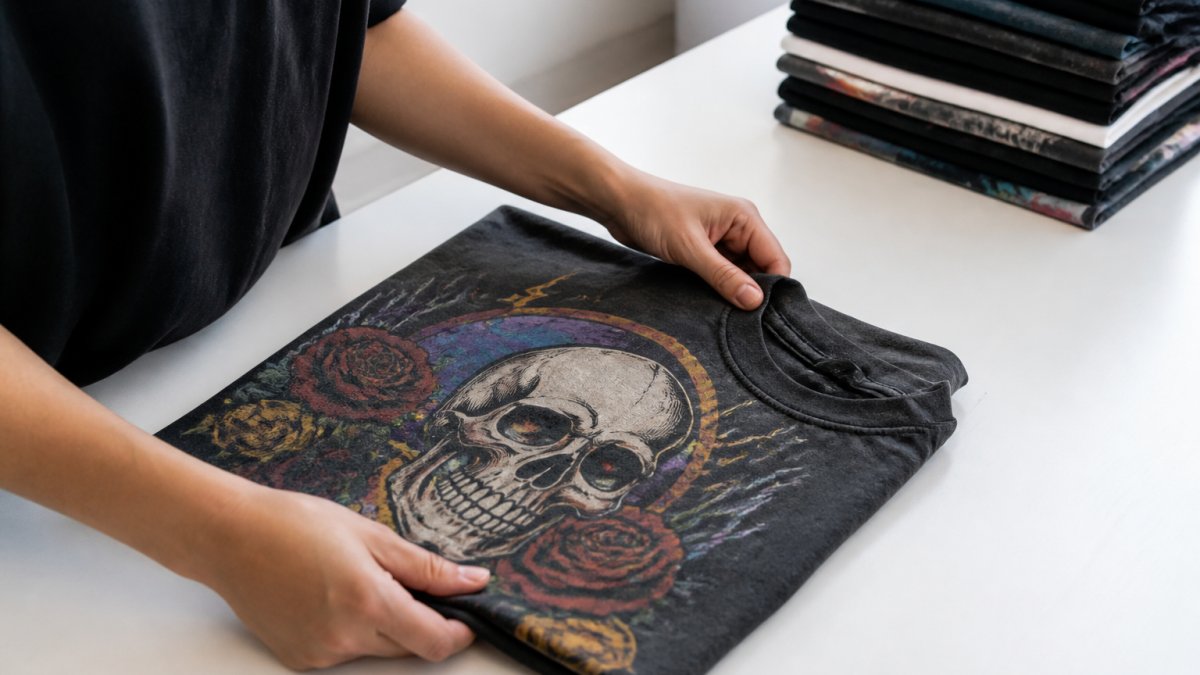
Here is the fold that protects the print:
- Turn the shirt inside out to shield the graphic from friction.
- Lay it flat on a clean surface and smooth out wrinkles with your hands.
- Fold both sleeves inward so they rest along the back.
- Fold the shirt in half lengthwise, then in thirds.
- Place a sheet of acid-free tissue paper over the graphic before stacking.
That last step matters more than people think. Tissue paper stops two prints from rubbing together, which is how cracks start.
A common mistake is folding right on the graphic line. That crease becomes permanent over time. Fold between prints, not across them.
How to Store T-Shirts Long Term Without Ruining the Fabric
Long-term storage means the shirt will sit untouched for months or longer. That changes the rules.
For anything you will not wear for a while, use flat storage. A shallow archival box lets shirts rest without weight pressing down on them. Never stack more than three or four shirts in one pile.
- Light rotation: shirts you wear often, folded in a drawer
- Medium term: a few months, flat in a box with tissue between layers
- Long term: years, flat storage in a cool, dark place with acid-free materials
Avoid wire hangers entirely if you do hang anything. They leave shoulder dents and can rust, which stains fabric. Use a padded hanger for delicate pieces, and only for short periods.
How to Prevent T-Shirts From Yellowing in Storage
Yellowing is not one problem. It is at least four, and each has a different fix.
**1.
2. Acid migration from storage materials. Standard cardboard, newsprint, and wood shelving are acidic. Over time, those acids migrate into the fabric and cause browning, especially along fold lines.
3. Light exposure. Ultraviolet light breaks down both the cotton cellulose and the plastisol or water-based ink in the print.
4. Heat and humidity swings. Heat accelerates every chemical reaction above.
Fabric and print differences that change the fix
- Heavy 100% cotton from the 1970s-1990s: most prone to acid migration and fold-line browning. Use unbuffered acid-free tissue and rotate fold lines every six months.
- 50/50 cotton-poly blends: less prone to browning but more prone to heat-set yellowing near the print. Keep them out of warm closets and away from water heaters.
- Cracked or flaking plastisol prints: the ink itself yellows and can transfer to whatever it touches. Store print-side up, never print-on-print, and interleave with tissue.
- White or light-colored tees: show yellowing first and worst. Give them their own box so you can inspect them more often.
- Dyed or black tees: yellowing shows as a dull, gray cast rather than a stain. Same causes, harder to spot.
A wash routine that actually removes the residue
A gentle hand wash with a mild, pH-neutral detergent is the standard recommendation for vintage cotton. Skip fabric softener, bleach, and enzyme-heavy detergents, they leave residue or weaken old fibers. Rinse thoroughly, then air dry flat and away from direct sun.
Let the shirt dry completely, 24 hours on a clean towel in a ventilated room is a safe rule of thumb. Any moisture left in the fabric becomes mildew, and mildew stains are effectively permanent on cotton.
Storage choices that stop yellowing at the source
- Use acid-free, lignin-free boxes and unbuffered acid-free tissue for dyed and printed vintage cotton. Buffered tissue is fine for plain white cotton but can react with some dyes and prints.
- Never store shirts in regular cardboard, on bare wood shelves, or wrapped in dry-cleaning bags. All three off-gas or trap residue.
- Store shirts inside out so any surface fading hits the inside, not the graphic.
- Keep storage dark, a closed archival box in a closet beats an open shelf in a bright room every time.
- Rotate fold lines every six months so no single crease becomes a permanent yellow line.
How to Organize a T-Shirt Collection You Can Actually Use
A collection you cannot find is a collection you will not wear. Organization is part of preservation, not separate from it.
Start with a simple inventory. A spreadsheet or a notes app works fine. For each shirt, log:
- Band, artist, or fandom
- Year or era
- Condition (mint, good, worn)
- Storage location
Then group shirts by how often you reach for them. The ones you wear weekly go in easy-access drawers. The rare or fragile pieces go into long-term flat storage.
Choosing Storage Materials: Boxes, Tissue, Bags, and Hangers
The materials you choose decide whether a shirt survives. Cheap materials cause the damage you are trying to prevent.
| Material | Best For | Avoid If |
|---|---|---|
| Acid-free archival box | Long-term, valuable pieces | You need frequent access |
| Cardboard box | Short-term, sturdy shirts | Storing for more than a year |
| Acid-free tissue paper | Layering between prints | You need a quick, cheap fix |
| Breathable garment bag | Hanging display pieces | You need airtight protection |
| Padded hanger | Delicate shirts, short term | Shirt is heavy or old |
| Wire hanger | Nothing | Always |
Cardboard is the trap. It looks harmless, but it is acidic and off-gasses over time. That is a slow path to yellowing and brittle fabric.
National Park Service guidance on storing historic textiles recommends acid-free, unbuffered tissue paper for delicate dyed fabrics. For a vintage graphic tee, that is the right call.
Pest Prevention, Humidity Monitoring, and Environment Targets
Most storage guides stop at "keep it cool and dry." That is not a plan. Here is what to actually monitor, what numbers to aim for, and what to do when a space fails.
Environment targets worth writing down
Textile conservation guidance from major museums converges on a narrow range for historic fabric. For a vintage graphic tee collection, aim for:
- Relative humidity: 45-55%, held as steady as possible. Below 40% and old cotton can become brittle; above 65% and mold, mildew, and pest activity rise sharply.
- Temperature: 65-70°F, again as stable as possible. Every 10°F increase roughly doubles the rate of chemical degradation in cotton and print inks.
- Light: dark. No direct sun, no bright display lighting on stored pieces. UV damage is cumulative and irreversible.
- Airflow: gentle, not sealed. Shirts need to breathe; sealed plastic traps moisture and off-gassing.
A basic digital thermo-hygrometer costs very little and tells you more than any rule of thumb. Place one inside the storage closet or box area, not in the hallway outside it. Check it weekly for the first month, then monthly. Log the readings, patterns matter more than single readings.
What to do when a space runs damp
Basements, garages, and exterior-wall closets swing between damp and dry, which is worse for fabric than a steady-but-imperfect space. If your monitor shows humidity above 60% for more than a few days:
- Move the collection to an interior closet or a climate-controlled room.
- Add a silica gel desiccant (rechargeable, food-grade) inside each archival box, not loose in the closet.
- Run a small dehumidifier in the room, not pointed at the shirts.
- Never store shirts flat against an exterior wall, concrete floor, or below-grade surface.
If humidity drops below 40% in winter, a room humidifier set to 50% is safer than letting the fabric dry out further.
A pest inspection routine that actually catches problems early
Moths, carpet beetles, silverfish, and firebrats are the main threats to stored cotton. They prefer dark, undisturbed, protein-rich material, which is exactly what a neglected storage box becomes. The fix is not a chemical; it is a schedule.
Every three months, do a five-minute inspection:
- Open each box and lift the top layer of tissue. Look for frass (fine powder), cast skins, webbing, or small holes along fold lines and collars.
- Check the underside of collars, cuffs, and hems first, those areas hold the most body oils and attract pests.
- Vacuum the storage area (not the shirts) with a HEPA vacuum to remove eggs and debris.
- Re-seal boxes fully. Gaps at corners are entry points.
If you find activity:
- Isolate the affected shirts in a separate breathable bag or box, away from the rest of the collection.
- Do not spray insecticide on the garments. Most products sold for household pests will stain, weaken, or discolor vintage cotton and print inks.
- Freeze treatment is the standard museum method for infested textiles: seal the shirt in a vapor-proof bag, freeze at 0°F or below for at least 72 hours, then let it return to room temperature fully sealed before opening. Repeat once after two weeks to catch newly hatched larvae.
- For valuable or fragile pieces, contact a textile conservator rather than treating at home.
Prevention that works without chemicals:
- Cedar blocks and lavender sachets deter some pests but do not kill larvae. Treat them as a supplement, not a solution.
- Keep storage areas clean, dry, and free of wool, fur, and paper clutter that harbor pests.
- Inspect new acquisitions before they enter the collection. A single infested shirt can seed an entire closet.
Frequently Asked Questions
Should you fold or hang vintage graphic T-shirts?
Fold them. Hanging stretches the shoulders and neckline over time, especially on older cotton. Wire hangers are worse because they rust and leave marks. If you must hang a shirt for display, use a padded hanger and rotate it off the rod regularly. For long-term storage, fold flat and stack loosely so the print does not crease or crack.
Are plastic bags safe for storing vintage T-shirts?
Only if they are specifically made for textiles. Dry cleaning bags and zip-top kitchen bags trap moisture and can cause yellowing, mildew, and dry rot. If you want bag protection, use acid-free, unbuffered tissue paper wrapped around the shirt, or a breathable cotton garment bag. Never seal a vintage tee in plastic for months at a time.
Should vintage T-shirts be washed before storage?
Yes, if they are dirty or have been worn. Body oils, deodorant, and food stains attract pests and cause yellowing over time. Hand wash in cool water with a gentle detergent, turn the shirt inside out, and air dry completely before folding. If the shirt is fragile or has a cracked print, spot clean only and let it dry fully in a shaded, ventilated area.
What is the best container for storing vintage clothing?
Acid-free archival boxes or clean cardboard boxes lined with unbuffered tissue paper work best. Avoid sealed plastic bins because they trap humidity. If you use a plastic bin, leave the lid slightly cracked and add a desiccant pack. Keep boxes off the floor and away from exterior walls to reduce temperature swings and pest access.