

How to Find Unique Vintage Inspired Band Tees
Last Updated: October 30, 2026
Quick Summary
Find unique vintage inspired band tees by searching with intent instead of scrolling feeds: pick an era, band and vibe first, then use specific terms like band plus year plus shirt or single stitch. Shop marketplaces, independent sellers and made-to-order shops, and verify tags, stitching and print quality before paying.
- Decide upfront whether you want an original vintage piece or a vintage-style reproduction, since that sets budget and search terms.
- Search three different ways before concluding a design does not exist, because sellers describe the same shirt differently.
- Run every candidate through a tag, stitching, print, proportions and wear check before buying.
- Compare flat measurements like pit to pit and body length instead of trusting size labels across eras.
- Pay a premium only when the design is unseen elsewhere, measurements and tag close-ups are provided, and condition is documented.
Table of Contents
- Start With a Search Plan, Not a Scroll
- Define the Era, Band, and Vibe Before You Browse
- Use Search Terms That Surface Hidden Listings
- Where to Buy Band T-Shirts Online Without Sorting Through Generic Drops
- How to Spot Authentic Vintage Concert Tees vs. Vintage-Inspired Reprints
- Hunting Local: Thrift Stores, Estate Sales, and Record Shops
- Band Tee Sizing and Fit Across Decades and Sellers
- Price Ranges and What Actually Drives Value
- How to Style a Band Tee So It Looks Intentional, Not Costume
- Build Your Rotation With Made-to-Order Pieces From Hot Takes Designs
- Frequently Asked Questions
Start With a Search Plan, Not a Scroll
Finding vintage inspired band tees that don't look like everyone else's is a search problem before it's a shopping problem.
Here's the uncomfortable truth: the tee you want rarely shows up in a feed. It shows up when you search with intent, know what you're looking at, and move fast.
Most guides skip the part where you define what "unique" actually means to you. That's the step that changes everything.
Define the Era, Band, and Vibe Before You Browse
Random browsing produces random results. Pick three things first: an era, a band or genre, and a vibe.
Era matters more than most shoppers realize.
Vibe is the tiebreaker. Are you after faded and distressed, crisp and graphic, or something deliberately ironic?
A common mistake is chasing a specific tour shirt without accepting that originals are scarce.
Use Search Terms That Surface Hidden Listings
Generic searches return generic results. Specific searches surface the good stuff.
Try these patterns:
- Band + year + shirt: narrows to a tour or era
- Band + "vintage" + "single stitch": flags older construction
- "Distressed" + genre + tee: catches worn-in reproductions
Add "rare," "collectible," or "one-of-a-kind" when you want the long tail. Save your best searches and set alerts where the marketplace allows it.
What most guides miss is that sellers describe the same shirt in wildly different language. Search three ways before you conclude a design doesn't exist.
Where to Buy Band T-Shirts Online Without Sorting Through Generic Drops
Online is where selection lives, but it's also where the noise lives. Split your sources into three buckets and shop each differently.
For a concrete example of a unique piece you can buy today, look at the DWAEKKI Vintage Oversized Heavyweight Tee.

Watch out: listings using only stock photos with no close-up of the print or tag are the ones that disappoint.
How to Spot Authentic Vintage Concert Tees vs. Vintage-Inspired Reprints
Authentic vintage concert tees are original shirts printed and sold around the time of a tour or release. Vintage-inspired reprints are new garments designed to look old. Both can be great. Confusing them is where money gets lost.
Tags, Stitching, and Print Quality: The Three-Point Check
Run every candidate through this checklist:
- Tag: does the label match the era the seller claims? Older tags are often single-stitch and simpler in design.
- Stitching: single-stitch hems and sleeves point older; double-stitch points newer.
- Print: crackled, faded ink with soft hand feel suggests age. Crisp, thick, rubbery ink suggests a modern print.
A reproduction sold honestly as vintage-style is a fine buy. A reproduction sold as an original is a counterfeit. Ask the seller directly which one it is, in writing.
Once you own pieces worth keeping, the guide to storing a vintage graphic t-shirt collection covers how to protect them long term.
Hunting Local: Thrift Stores, Estate Sales, and Record Shops
Local hunting still beats the algorithm for one-of-a-kind finds.
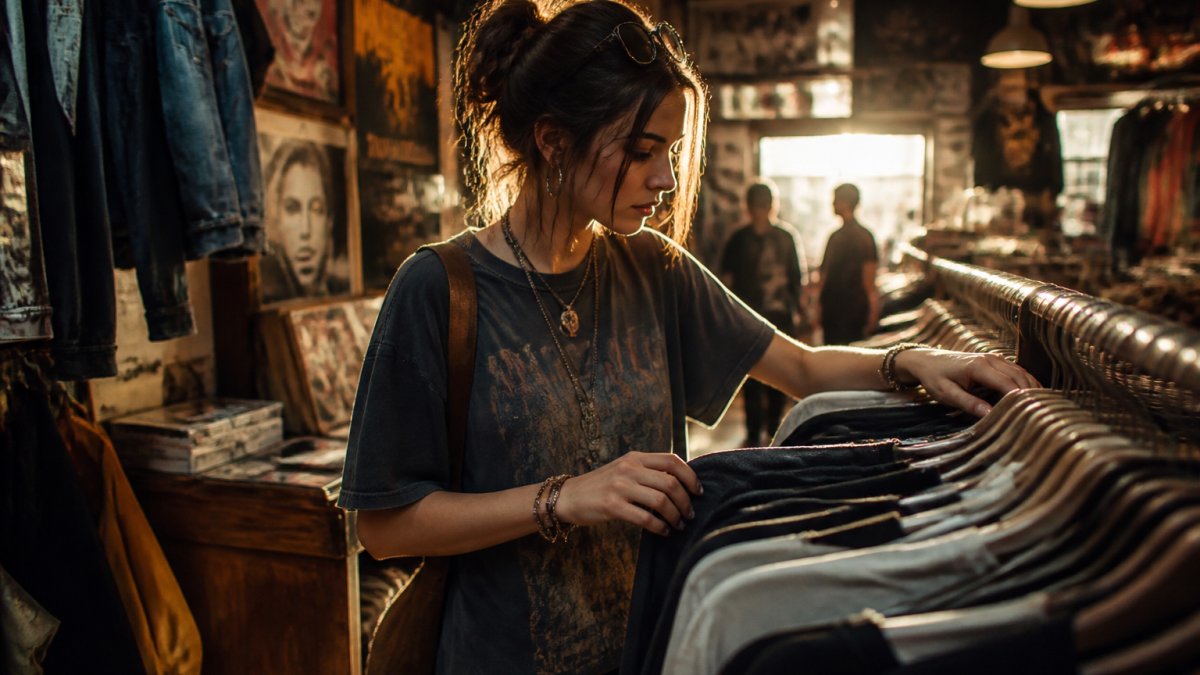
Go early and go often. Thrift stores restock unpredictably, and estate sales concentrate decades of one person's collection into a single weekend.
Bring a mental checklist: era, tag, stitching, print. Check the men's section regardless of your size, since oversized fits are the point.
The tradeoff is time. Local hunting is slow, and most trips produce nothing.
Band Tee Sizing and Fit Across Decades and Sellers
Sizing is the biggest source of returns in this category. A "large" from 1985, a "large" from 2003, and a "large" from a made-to-order shop in 2026 are three different garments. Here is a translation system for comparing sizes across eras and sellers.
DWAEKKI" Vintage Oversized Heavyweight Tee | Stray Kids SKZ Stay Fandom →
Measure the shirt, not the label
Ignore the size tag until the end. Measure a tee you already love, laid flat, and write down four numbers:
- Pit to pit (armpit seam to armpit seam, straight across)
- Body length (collar seam at the back to the bottom hem)
- Sleeve length (shoulder seam to sleeve hem)
Then ask the seller for the same four measurements on the candidate shirt. Compare numbers, not letters. A vintage "L" that measures 20 inches pit to pit is closer to a modern medium; a made-to-order "L" at 23 inches pit to pit is a true modern large. If a seller will not provide flat measurements, treat that as a pass.
Era-by-era fit expectations
Use these as starting points, then confirm with measurements:
- 1970s: short body, boxy through the chest, thin and soft cotton, often 100% cotton with a paper-thin hand. Expect shrinkage of roughly half an inch to an inch in length after decades of washing.
- 1980s: boxier shoulders, wider sleeves, louder graphics, often 50/50 cotton-poly blends that feel smoother and resist shrinking.
- 1990s: oversized through the body with dropped shoulders on grunge and punk tees; heavier ring-spun cotton on many prints.
A common pattern: shoppers size up "just in case" on a vintage piece. Old cotton has already shrunk as far as it is going to. Measure instead of guessing.
Reproductions and made-to-order sizing
Reproductions are cut to modern patterns, so a modern large usually fits like a modern large, but check two things: whether the fabric is pre-shrunk, and whether the shop grades sizes from a real pattern or scales up a small. Graded patterns keep shoulder, chest, and length proportional across the size run; scaled-up patterns distort at the extremes. If a shop publishes a size chart with chest, length, and sleeve for every size from 2XS to 6XL, that is a signal the pattern was graded.
If you are translating between eras and want a clearer starting point, the women's sizing guide for literary graphic tees walks through how to map fit expectations onto an actual purchase.
Fit checks before you commit
- Shoulder seam: should sit at or just past your natural shoulder on a vintage fit; dropped shoulders are intentional on 1990s cuts.
- Body length: vintage tees often run short; if you are tall, confirm length first.
- Sleeve hem: on 1970s and 1980s tees, sleeves are often shorter and wider, that is the era, not a defect.
Use these era-by-era starting points, then confirm with flat measurements before you buy.
| Era | Fit and fabric expectations |
|---|---|
| 1970s | Short body, boxy chest, thin soft cotton; expect some shrinkage |
| 1980s | Boxier shoulders, wider sleeves, louder graphics, cotton-poly blends |
| 1990s | Oversized body, dropped shoulders, heavier ring-spun cotton |
| Early 2000s | Slimmer through the body, longer in length |
| Reproductions | Modern patterns; check pre-shrunk fabric and graded sizing |
Price Ranges and What Actually Drives Value
Price in this category tracks four things: rarity, condition, provenance, and construction. Here is how to read a listing and decide whether the number is fair.
The four value drivers, in order of impact
- Rarity. A one-off design, a short-run tour shirt, or a piece tied to a specific date commands the most. Common album-art reprints command the least.
- Condition. Condition moves the number fastest. Stains, holes, heavy fading, and repairs all pull it down; unworn deadstock with original tags pulls it up.
- Provenance. A documented tour, a known seller, or original tags add confidence and cost. A listing with no backstory and no tag close-up is priced as a gamble, and should be.
- Construction. Heavyweight premium cotton and clean double-stitched seams hold value better than thin, flimsy blanks.
Condition grades to ask about
Sellers use loose language. Ask for these five grades in writing:
- Deadstock / new old stock: unworn, often with original tags; expect the highest price.
- Excellent: worn lightly, no flaws, print intact.
- Good: visible wear, minor fading, no holes or stains.
A faded print is not automatically damage. On originals, even fading is part of the look. On a new shirt, uneven fading means a cheap print. If you want your prints to stay sharp, the guide to keeping printed t-shirts from fading in storage is worth the read.
When a premium is justified
Pay up when three or more of these are true: the design is one you have not seen elsewhere, the seller provides flat measurements and tag close-ups, the condition grade is documented, and the seller answers authenticity questions in writing. Walk away when the listing uses only stock photos, refuses measurements, or prices a reproduction as an original.
Made-to-order pricing as a benchmark
Our own made-to-order pieces include the Latchkey Kids Club vintage graphic tee at $30.50 and the Vintage Caffeine Skeleton tee at $26.50. Made to order, each piece is printed with vibrant, long-lasting prints on ultra-soft fabric.
Shipping, returns, and total cost
Factor shipping and return policy into the number you compare. A cheaper listing with no returns can cost more than a slightly higher listing with free returns. Check whether the seller ships tracked, whether returns are accepted on vintage, and who pays return shipping. The fair price is the total landed cost of a shirt that fits, not the sticker price.
How to Style a Band Tee So It Looks Intentional, Not Costume
Styling is where vintage-inspired tees either sing or look like a Halloween outfit. The fix is contrast and restraint.
Pair one loud piece with quiet ones. A graphic tee under a plain blazer, tucked into tailored trousers, reads intentional.
Tuck or knot the hem to change the silhouette. Roll the sleeves once.
The rule we'd give a friend: one statement per outfit. Let the tee win.
Build Your Rotation With Made-to-Order Pieces From Hot Takes Designs
The hardest part of building a rotation of unique band tees is that originals are finite, inconsistent in size, and often one wash away from falling apart.
Every piece is custom-printed, cut, and sewn to order on ultra-soft fabrics, with vibrant, long-lasting prints. Sizes run from 2XS to 6XL.
Start with a single piece that matches the era and vibe you mapped out, then build from there.
Frequently Asked Questions
Where is the best place to buy vintage inspired band tees?
It depends on whether you want an original or a reprint. For originals, estate sales, thrift stores, and independent online sellers tend to have the most one-of-a-kind finds, though inventory is unpredictable. For vintage-inspired tees, made-to-order shops give you consistent sizing, soft fabrics, and prints that hold up. Many buyers run both tracks at once: hunt originals locally while ordering a few reliable reprints for concerts and everyday wear.
How can you tell whether a band tee is vintage or vintage-inspired?
Check three things: the tag, the stitching, and the print. Original vintage concert tees usually carry single-stitch hems, older brand tags, and cracked or softened screen print ink. Vintage-inspired tees typically use double stitching, modern tag styles, and crisp prints with a deliberately faded wash. Ask sellers for close-up photos of the tag and hem before buying, and be wary of listings that show only styled full-body shots with no detail images.
What should I check before buying a band tee online?
Confirm measurements rather than labeled size, since band tee sizing and fit vary widely by decade and seller. Ask for pit-to-pit and length numbers, request photos of any flaws, and check the seller's return policy. Read reviews for print durability, especially on reprints. If a listing claims authentic vintage concert tees at a suspiciously low price with no tag photos, treat it as a reproduction until proven otherwise.
How do you style a vintage-inspired band tee without looking like you tried too hard?
Balance the graphic with simple, structured pieces. Pair an oversized faded tee with straight-leg denim or cargo pants, then add one focal layer like a flannel or cropped jacket. Tuck the front hem slightly to define the waist, and keep accessories minimal so the print leads. For a cleaner look, size down for a fitted silhouette and wear it under a blazer. The goal is one loud element, everything else quiet.
Finding a tee that feels genuinely yours takes a plan, a sharp eye for tags and stitching, and a willingness to walk away from a bad listing. When originals are scarce or the fit never works, made-to-order is the reliable path. Get started with Hot Takes Designs and build a rotation of vintage-inspired band tees that actually fits you.
