

Why Custom Garments Cost More: A Breakdown
Table of Contents
- Why Custom Garments Cost More: The Real Breakdown
- Labor and Craftsmanship: The Human Factor
- Bespoke vs Made-to-Measure Pricing: What's the Difference
- Material Quality and Fabric Sourcing
- How to Price Custom Garments: What Goes Into the Cost
- The Custom Clothing Manufacturing Process Explained
- Cost-Per-Wear Analysis: Is It Actually Worth It
- Conclusion
Last Updated: August 16, 2026
Why Custom Garments Cost More: The Real Breakdown
Custom garments cost significantly more than off-the-rack options because they demand individual attention at nearly every production step. At Hot Takes Designs, we specialize in made-to-order custom apparel and are transparent about pricing: you're not just paying for fabric and thread, but for craftspeople, precision, and work built specifically for you.
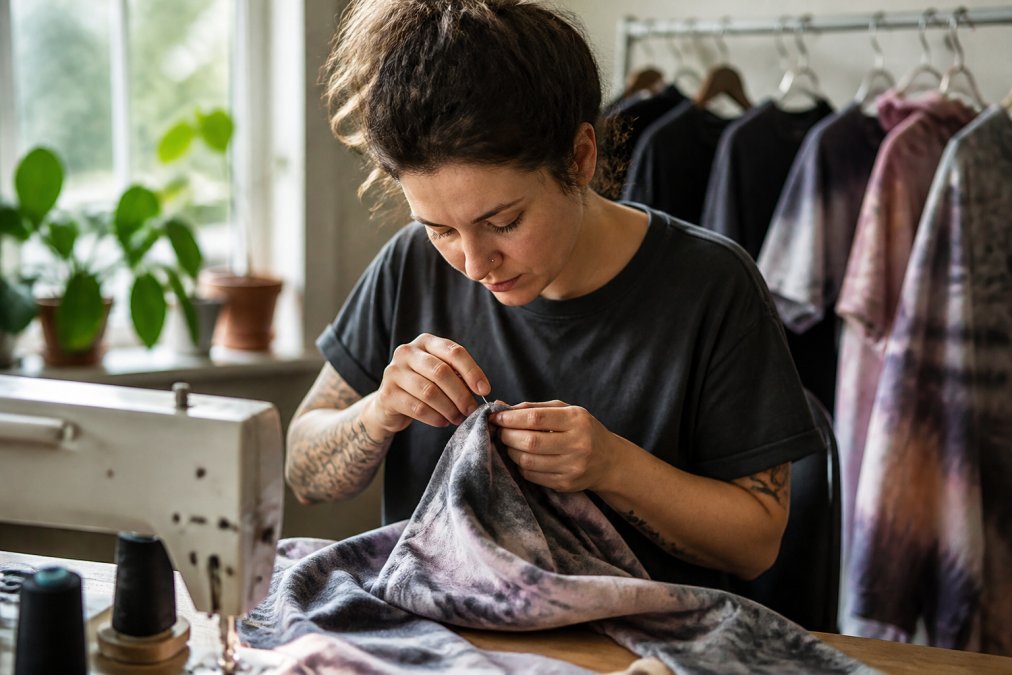
The difference comes down to scale and priorities. Mass manufacturers optimize for volume; custom makers optimize for fit, quality, and individuality. Those opposite goals produce opposite price tags.
Labor and Craftsmanship: The Human Factor
Labor is the biggest driver of custom garment costs. A seamstress creating a custom piece spends hours on work that machines complete in seconds for mass production.
Pattern grading exemplifies this. Mass producers grade a pattern once per size; custom makers adjust patterns for individual orders, different shoulder widths, sleeve lengths, torso proportions. A skilled pattern maker reviews specifications and makes adjustments by hand.
Construction also differs fundamentally. Factory workers perform one task repeatedly; custom makers construct entire pieces or large sections, switching between techniques and making micro-adjustments throughout. A factory worker might spend 15 minutes on a mass-produced tee; a custom maker spends 2-3 hours on yours.
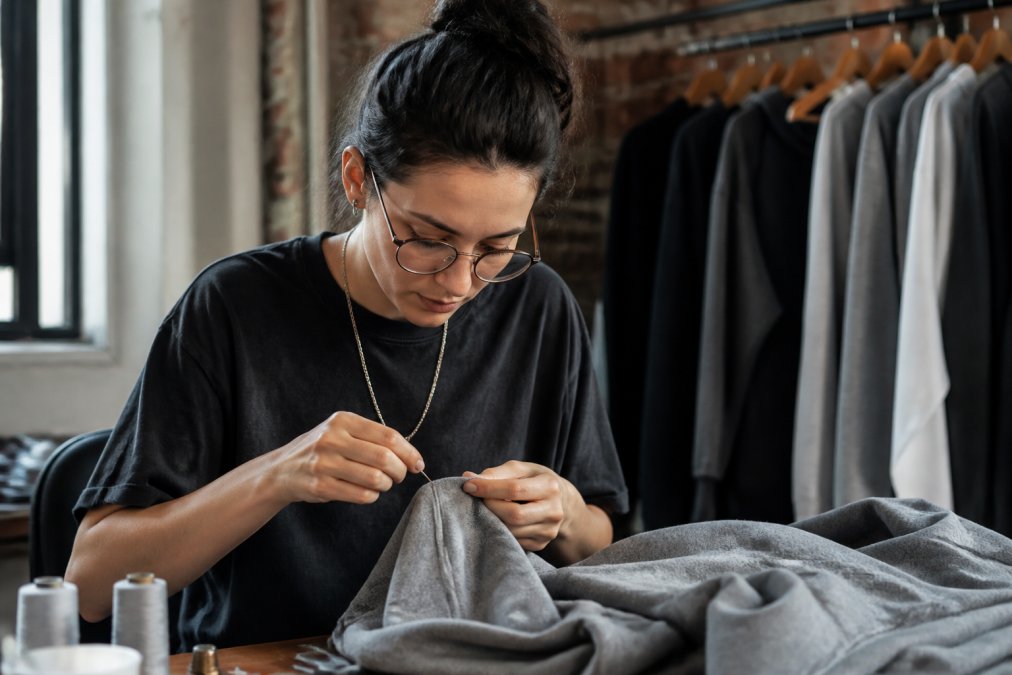
Quality control is manual and continuous. Custom makers inspect their own work throughout construction, catching loose threads and uneven seams that machines might miss. You're paying for hours of skilled human attention per piece.
The seamstresses capable of custom work have spent years developing pattern-making skills and troubleshooting fit issues. That expertise commands higher wages than entry-level assembly work.
Bespoke vs Made-to-Measure Pricing: What's the Difference
"Custom" encompasses different production methods with different price points.
Made-to-measure starts with an existing pattern template. A maker takes your measurements, adjusts the base pattern to fit your proportions, and constructs the garment. This is faster and less expensive than bespoke because foundational design work is already done. A made-to-measure piece might cost 30-50% more than a comparable mass-produced garment.
Bespoke means the pattern is created from scratch, often from in-person body measurements. The garment is typically made twice: a first prototype (muslin) is constructed, fitted on you, adjusted, then the final piece is made using refined specifications. Bespoke can cost 2-3x as much or more because you're commissioning original design work and undergoing multiple construction cycles.
Hot Takes Designs offers made-to-order custom apparel. We start with proven patterns, grade them to your measurements, and construct your piece with attention to detail, but without the design-from-scratch phase or multiple fittings. This delivers premium quality without bespoke price points.
Material Quality and Fabric Sourcing
Mass manufacturers buy fabric in enormous volumes, thousands of yards of identical weave, dye lot, and weight, negotiating prices custom makers cannot match. A custom maker might order 50-100 yard quantities; a factory orders 5,000-yard rolls. The per-yard cost difference is substantial.
However, custom makers typically source higher-quality fabric than mass producers. While factories optimize for cost and speed, custom makers optimize for durability and longevity. Quality fabric uses better-quality cotton (combed rather than carded), tighter weaves, and more consistent dye processes, all costing more per yard.
Hot Takes Designs uses ultra-soft fabrics and vibrant, long-lasting inks because we prioritize quality over lowest cost. A custom maker might use 6-ounce jersey knit instead of 4-ounce because it holds its shape better and lasts longer.
Custom makers also experience more waste than factories. A factory cutting 10,000 identical pieces optimizes layouts to minimize scrap; a custom maker cutting individual pieces for different sizes has more waste, built into the cost.
How to Price Custom Garments: What Goes Into the Cost
Understanding custom garment pricing requires breaking down actual cost components.
Materials (fabric, thread, notions, packaging) form the floor: $5-8 for a basic tee, $8-15 for complex pieces. Labor is next, a seamstress paid $20/hour spending 2 hours on a piece adds $40 in labor costs. Labor typically represents 40-60% of final price.
Overhead (workspace, equipment, insurance, administrative time) adds 20-30% of direct costs. Design and pattern work adds 5-10% for made-to-measure. Quality control, packaging, and shipping add another 10-15%.
A simple example: a custom tee with $7 materials, 1.5 hours labor at $20/hour ($30), $15 overhead, $5 pattern grading, and $8 packaging totals $65 in costs. A reasonable 30-50% markup brings retail price to $85-100, modest compared to mass production's 5-10% markup.

The Custom Clothing Manufacturing Process Explained
Mass production starts with design approval, pattern grading for all sizes, bulk fabric ordering, and cutting. Hundreds of pieces move through stations simultaneously, optimized for speed.
Custom manufacturing is sequential and individual:
Measurement and specification. The customer provides measurements or the maker takes them. Special requests are documented, a step that doesn't exist in mass production.
Pattern grading. The base pattern is adjusted to customer measurements. This skilled work accounts for how different sizes should fit differently, not just scaling.
Fabric selection and preparation. Appropriate fabric is selected, inspected for flaws, and cut to required length with waste accounted for.
Cutting. Pieces are cut for that specific size and requirements, unlike factory cutting where one layout serves thousands.
Construction. The garment is sewn in multiple stages: assembling the main body, attaching sleeves, setting collars, hemming. Each stage is done by hand or single-operator machine.
Quality check. The finished piece is inspected for seam quality, fit, and imperfections.
Finishing. Final adjustments are made, labels attached, and the piece is pressed and folded.
Packaging and shipping. The finished garment is prepared for delivery.
This process takes 1-3 weeks; factories produce the same item in 1-2 days because thousands move through simultaneously. The factory spreads overhead across thousands of units; the custom maker spreads it across dozens or hundreds.
Pattern Making and Prototyping
Pattern making represents significant custom garment cost. For factories, it happens once per design. For custom makers doing made-to-measure work, pattern grading happens for every order.
A skilled pattern maker adjusts proportions correctly, not just scaling but grading sleeve cap height, armhole depth, shoulder width, and torso length proportionally. A simply scaled pattern looks wrong; a graded pattern looks right.
Bespoke work includes prototyping: constructing a muslin in inexpensive fabric, fitting it on the customer, refining based on actual fit, then creating the final pattern and garment. That's two full construction cycles, explaining bespoke's high cost.
Cut and Sew Operations
Factory workers using automated cutters process hundreds of pieces per hour. Custom makers cut individual pieces at human speed, checking grain lines and accounting for pattern placement. Nap fabrics like velvet require special consideration and can't be cut from a single layout.
Sewing similarly differs. Assembly line workers sewing one seam hundreds of times daily are incredibly efficient at that task. Custom makers sewing entire garments switch between techniques, check alignment, and make adjustments. It's slower but enables real-time quality control.
Cost-Per-Wear Analysis: Is It Actually Worth It
The real question isn't whether custom garments cost more, they do. It's whether they're worth it, determined by cost-per-wear: price divided by number of wears.
A $100 piece worn 50 times costs $2 per wear. A $30 piece worn 10 times costs $3 per wear. The expensive piece is actually cheaper.
Custom garments typically offer higher cost-per-wear advantages because they last longer and get worn regularly. Better fit means more wear, a perfectly fitting garment gets worn far more than a poorly fitting one. Higher quality construction means durability; a custom piece might last 100+ wears while fast-fashion equivalents last 20-30. Emotional investment matters too, a custom piece you designed gets worn more than something generic.
A $100 custom tee worn 100 times is $1 per wear. A $20 fast-fashion tee worn 20 times is also $1 per wear, but you need 5 cheap pieces to replace one custom piece. The total cost is $100 for 100 wears either way, but the custom piece is one item versus five.
For fans building wardrobes around specific interests, K-Pop concert fits, BookTok-inspired styles, snarky graphic tees, custom pieces hit differently. They're not generic, so you wear them repeatedly. That drives cost-per-wear down dramatically.
Custom garments cost more because they're built differently. Every step involves individual attention, skilled labor, and choices mass production optimizes away. Whether that premium is worth it depends on your priorities. If you value fit, durability, and pieces expressing who you actually are, custom is where real value lives. Hot Takes Designs makes custom apparel designed specifically for fans who want their wardrobe to reflect their passions, whether that's K-Pop, BookTok, or bold graphic streetwear. Our pieces are made to order with ultra-soft fabrics and vibrant prints that last. When building a wardrobe that's authentically yours, the cost difference disappears into the cost-per-wear calculation. Get started with Hot Takes Designs and build a collection that actually represents you.
Frequently Asked Questions
Is custom-made clothing worth the extra cost?
Custom garments justify their higher price through durability, fit, and personalization. A well-made custom piece lasts years longer than mass-produced alternatives, reducing cost-per-wear over time. You're paying for craftsmanship, material quality, and a garment tailored to your body, not just a product stamped out in bulk. For fans seeking unique pieces like K-Pop concert fits or BookTok-inspired styles, custom options offer designs unavailable elsewhere, making the investment in quality and exclusivity worthwhile.
What's the difference between bespoke vs made-to-measure pricing?
Bespoke garments are fully custom-designed from scratch, involving multiple fittings, original pattern creation, and complete personalization, commanding premium prices ($500+). Made-to-measure uses existing patterns adjusted to your measurements, reducing design labor and cost ($100-300). Bespoke includes unlimited revisions and design input; made-to-measure offers less flexibility but faster turnaround. For most customers, made-to-measure delivers excellent fit and quality at a more accessible price point than true bespoke tailoring.
How does labor impact the cost of custom clothing?
Labor is the largest cost driver in custom garments. Skilled seamstresses, pattern makers, and designers invest hours per piece, work that can't be rushed or automated. A single custom garment may require 4-8 hours of skilled labor, compared to minutes for mass production. Fair wages for quality craftspeople, pattern making, fittings, and quality control all add to labor costs. This hands-on work is why custom pieces from makers like Hot Takes Designs maintain superior durability and fit compared to fast fashion alternatives.
Why does the custom clothing manufacturing process cost more than mass production?
Custom manufacturing skips economies of scale. Mass production spreads fixed costs across thousands of identical items; custom production means every piece bears its own overhead. Pattern making and prototyping happen per-order, not once for millions. Cut-and-sew operations handle one or small batches instead of bulk runs. There's no material waste reduction from optimized cutting patterns. Supply chain transparency and ethical labor standards add cost. These factors combine to make custom production inherently more expensive per unit than fast fashion's assembly-line model.
This article was written using GrandRanker