

How to Tell Quality Graphic Tees: A 2026 Guide
Table of Contents
- What Makes a Quality Graphic Tee
- Fabric Quality and Weight (GSM) Matter More Than You Think
- Screen Print vs Digital Print Quality
- Construction Details That Signal Durability
- How to Wash Graphic Tees to Prevent Cracking
- Best Graphic Tee Brands for Long-Lasting Wear
- Your Visual Inspection Checklist
- Conclusion
Last Updated: August 5, 2026
What Makes a Quality Graphic Tee
A quality graphic tee depends on three measurable factors: the fabric itself, how the print is applied, and the construction details that hold everything together. The difference between a tee that stays vibrant and one that cracks, fades, and shrinks comes down to these specifics. At Hot Takes Designs, we've built our entire operation around getting these fundamentals right, because we know our customers are buying pieces they actually want to wear repeatedly, not disposable merch.

Most people don't realize they're making a quality judgment the moment they touch a shirt. That immediate reaction, whether the fabric feels substantial or thin, whether the seams look reinforced or flimsy, is your instinct picking up on real technical differences. Learning what those signals mean lets you shop with confidence instead of guessing.
Fabric Quality and Weight (GSM) Matter More Than You Think
GSM (grams per square meter) is the metric that separates a flimsy tee from one built to last. A quality graphic tee typically sits between 150-200 GSM, with the sweet spot around 180 GSM. Anything below 150 GSM feels thin, shows body shape too readily, and tends to pill quickly. Anything above 200 GSM becomes heavy unless the cotton is specifically processed to feel soft.
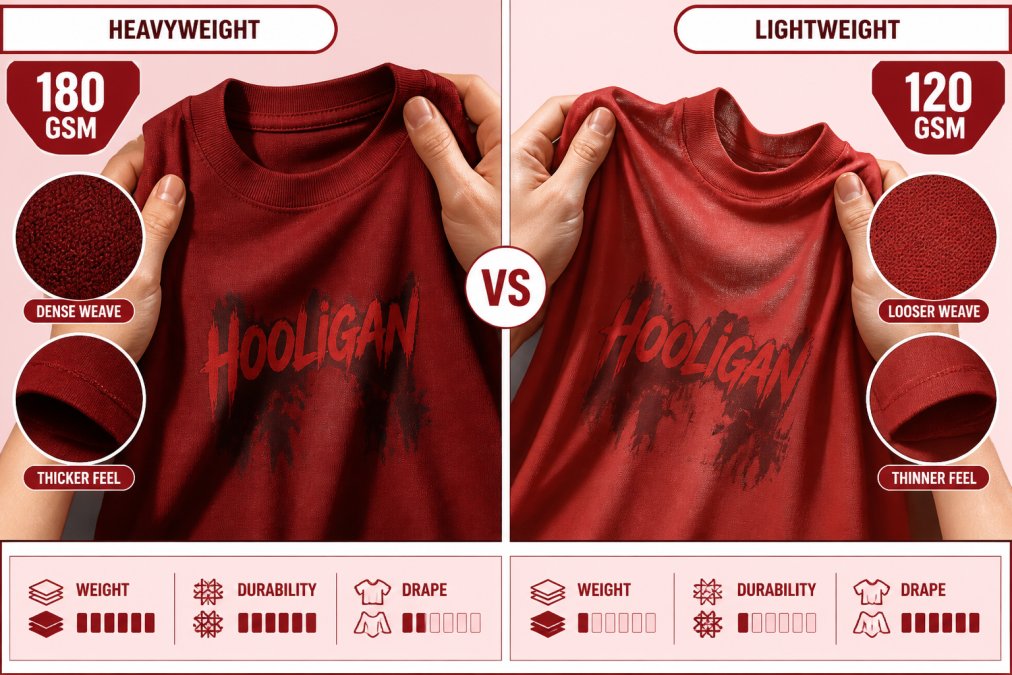
A heavier fabric has more fiber density, which means the print has more material to grip onto. When you wash a light 130 GSM shirt, the ink sits on a thin surface that flexes constantly, causing cracking. A 180 GSM shirt gives the print a stable base, so the ink moves with the fabric rather than breaking apart.

Understanding GSM and Cotton Types
Not all GSM is created equal because the type of cotton changes how the fabric feels and performs. Combed cotton is processed to remove short fibers, resulting in a softer, more durable fabric. Ring-spun cotton takes this further, it's twisted during spinning to create an even stronger, smoother yarn. Both cost more than standard cotton but deliver noticeably better longevity.
A 180 GSM ring-spun tee will feel softer, hold its shape better through washing, and resist pilling far longer than standard cotton. The print also adheres better to ring-spun fabric because the yarn surface is more uniform. Hot Takes Designs uses premium cotton blends for custom-printed pieces because fabric quality directly impacts how long your favorite design stays looking fresh.
Ring-Spun vs. Standard Cotton
Ring-spun cotton is twisted more tightly during spinning, creating yarn that's stronger and smoother. Standard cotton is processed more quickly and loosely, which is why it's cheaper but pills more easily and loses shape faster.
In practice, a ring-spun 180 GSM tee will outlast a standard cotton 180 GSM tee by several years of regular wearing. The fabric softens with washing rather than degrading, color holds better, and the print stays intact longer. If you're buying a graphic tee you actually care about, ring-spun cotton is worth the extra cost.
Screen Print vs Digital Print Quality
How the design gets onto the shirt matters as much as the shirt itself. Screen printing and direct-to-garment printing (DTG) are fundamentally different processes with distinct strengths.
Screen printing creates a stencil (screen) for each color, then pushes ink through onto the fabric. This uses thicker, more durable inks that sit on top of the fabric, creating a slightly raised texture. For bold, solid designs with limited colors, screen printing is virtually unbeatable for longevity, vintage band tees from the 1980s still have vibrant prints because the ink bonds chemically with fibers.
Direct-to-garment printing works like an inkjet printer for fabric, applying liquid ink directly onto the garment. This creates a soft-to-touch print that handles unlimited colors and photorealistic detail. The trade-off is that DTG ink sits more on the surface, making it more vulnerable to cracking if the fabric is thin or low-quality.
The best indicator of print durability is ink saturation and stitch density. A well-executed screen print uses enough ink to create a solid, opaque layer without bleeding. Quality DTG uses high-quality pigment inks and proper fabric pre-treatment. Both can last 50+ washes if done correctly.
When evaluating print quality, look at the design edges, blurry, feathered edges suggest bleeding or poor registration. Clean, sharp edges indicate precision. Run your finger over the print; it should feel smooth and consistent, not sticky or cracked. A plasticky or overly stiff feel suggests low-quality ink that will crack with movement.
Construction Details That Signal Durability
The seams, neckline, and shoulder construction determine how long the shirt survives regular wearing.
Seam Quality and Double-Needle Stitching
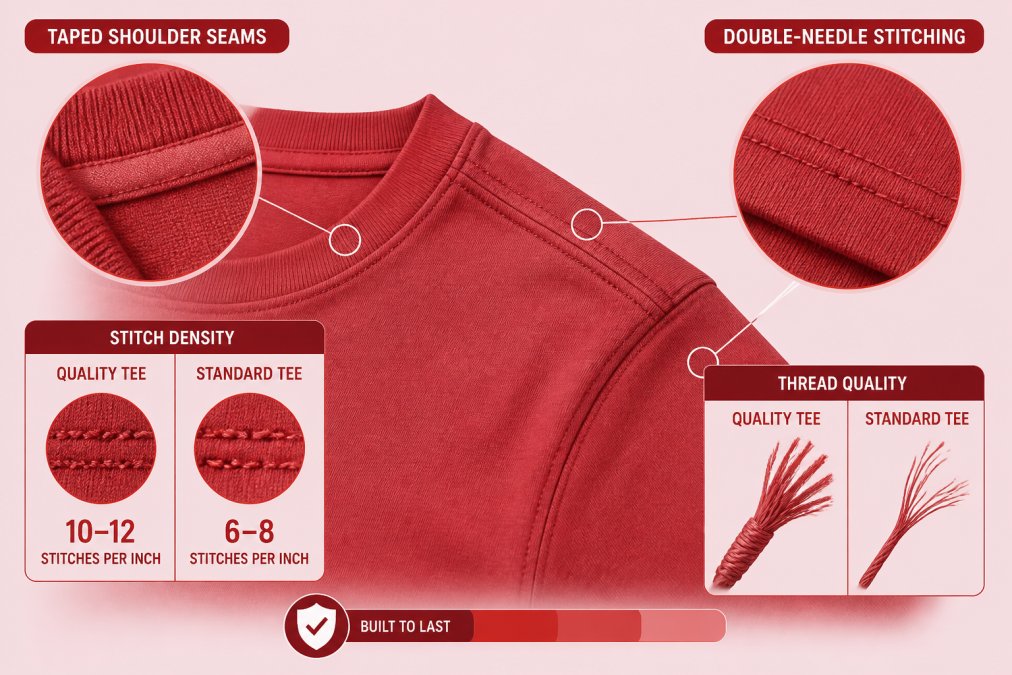
Double-needle stitching is the gold standard for tee construction. Instead of one line of stitches, the machine uses two parallel lines, creating redundancy, if one thread breaks, the seam doesn't immediately fail. A single-needle seam is cheaper but offers no backup.
Spot double-needle stitching by looking inside the shirt. Side seams and sleeve seams should show two distinct parallel lines. This is especially important on the armhole, where fabric gets stretched repeatedly. A double-needle armhole seam stays intact for years; a single-needle seam can split within months.
Quality polyester thread is stronger than cheap alternatives and stays intact through hundreds of wash cycles.
Neckline Integrity and Taped Shoulder Seams
The neckline reveals cheap construction immediately. A quality tee has a reinforced neckline that maintains shape after repeated washing. The best method is taped shoulder seams, a thin fabric strip sewn along the shoulder seam to prevent stretching.
Without taped seams, the shoulder stretches out of shape within months. With taped seams, the shirt maintains its original fit for years. Feel the inside of the shoulder seam; a taped seam feels like a thin, flat reinforcement.
The neckline binding should be thick enough to maintain elasticity. Cheap tees use thin binding that loses stretch after a few washes. Quality tees use substantial binding that stays snug.
How to Wash Graphic Tees to Prevent Cracking
Even a perfectly constructed tee can fail with improper washing. The most important rule: wash graphic tees inside out to protect the printed side from friction.
Wash in cold water with a gentle cycle. Hot water weakens ink adhesion and causes dyes to bleed. Use mild detergent designed for delicates or colors, standard heavy-duty detergents are too harsh. Skip bleach entirely.
Air dry whenever possible. Machine drying creates heat that can set creases and cause ink to crack. If you must use a dryer, use the lowest heat setting. Heat from the dryer is one of the primary causes of print cracking, especially for DTG prints.
Wash graphic tees less frequently than regular tees. If it doesn't have visible stains or odor, it doesn't need washing. Every wash cycle puts some stress on the print.
Best Graphic Tee Brands for Long-Lasting Wear
Finding a brand that prioritizes fabric quality and construction requires knowing what to look for. The best brands focus on GSM weight, print durability, and construction details rather than cutting corners.
Hot Takes Designs specializes in custom-printed apparel built for longevity. Each tee uses premium fabrics, primarily 180 GSM Sorona blends, paired with sublimation printing. Construction includes double-needle stitching on all seams and taped shoulder reinforcement. Because every piece is made to order, there's no warehouse inventory, ensuring fresher fabric and consistent quality control.

What separates Hot Takes from mass-market options is focus on the customer's actual use case. Whether you need tees for concert wear, content creation, or everyday wear, that specificity drives every production decision.
Beyond Hot Takes, look for brands that publicly specify GSM weight and cotton type. If a brand doesn't list these details, it often signals lower-quality materials. Brands that show their construction process, seam details, and print techniques stand behind their products.
Your Visual Inspection Checklist
Before buying any graphic tee, run through this checklist to identify quality signals.
Fabric:
- Hold the tee up to light. Quality tees don't show body shape.
- Feel the fabric. It should be smooth and consistent, not rough or pilly.
- Check GSM weight if available. 180+ GSM is the minimum for repeated wear.
- Look for combed or ring-spun cotton in fiber content.
Print:
- Examine design edges. Sharp, clean edges indicate precision.
- Run your finger over the print. It should feel smooth and consistent.
- Check for ink saturation. Colors should be opaque and vibrant.
- Look at the back of the shirt. Quality prints don't bleed through.
Construction:
- Turn the shirt inside out. Look for double-needle stitching on side seams and armholes.
- Check shoulder seams for tape reinforcement.
- Examine neckline binding. It should be thick and substantial.
- Look at overall stitch quality. Stitches should be evenly spaced and consistent.
Fit:
- Check the size chart carefully. Quality tees use consistent sizing.
- Sleeve length should hit mid-bicep. Body length should hit mid-hip.
- The fit should feel intentional, not accidentally shapeless.
| Inspection Point | What to Look For | Red Flag |
|---|---|---|
| Fabric Weight | 180+ GSM for durable wear | Below 150 GSM feels thin and fragile |
| Cotton Type | Combed or ring-spun | Standard cotton with no specification |
| Print Edges | Sharp, clean lines | Blurry, feathered, or bleeding edges |
| Seam Construction | Double-needle stitching visible | Single-needle seams throughout |
| Shoulder Seams | Taped reinforcement inside | No reinforcement, just basic seam |
| Neckline | Thick, substantial binding | Thin binding that looks like it will curl |
| Stitch Quality | Even, consistent spacing | Loose, uneven, or skipped stitches |
The difference between a graphic tee that becomes a favorite piece you wear for years and one that ends up in the donation pile comes down to specifics. Knowing how to evaluate fabric weight, print durability, and construction details gives you the power to make intentional purchases. When you're looking for tees that represent who you are, quality matters. Hot Takes Designs builds every tee with these principles in mind, using premium fabrics and construction methods designed for longevity. Start with the checklist above, and you'll never buy a disappointing graphic tee again.
Frequently Asked Questions
How can you tell if a screen print will last on a graphic tee?
High-quality screen prints have consistent ink saturation with no gaps or thin spots. Run your finger over the print, it should feel slightly raised and smooth, not cracked or peeling. Check the edges: they should be clean and defined, not blurry or feathered. After washing, quality prints maintain color fastness and don't crack or fade noticeably. Cheap prints show cracking within 5-10 washes because of poor ink adhesion and low stitch density in the fabric underneath.
What fabric weight is best for quality graphic tees?
Look for tees with 180-200 GSM (grams per square meter) for premium quality. This weight provides durability, breathability, and a substantial hand-feel without being stiff. Ring-spun cotton at this GSM resists pilling and maintains shape after repeated washing. Lower GSM (under 150) feels thin and flimsy; higher GSM (over 210) can feel heavy and restrict movement. For graphic tees specifically, 180-200 GSM is the sweet spot for comfort and longevity.
How do I know if a graphic tee brand is actually quality or just overpriced?
Check the fiber composition, premium brands use combed cotton or ring-spun cotton, not cheap blends. Examine seam construction: double-needle stitching on side seams and taped shoulder seams indicate quality. Look at the print technique; screen printing holds up better than direct-to-garment for long-term wear. Read wash care instructions and customer reviews about print durability. Brands that offer made-to-order production often maintain higher standards because they control quality at every step, unlike mass-produced alternatives.
What are the signs of a cheap graphic tee I should avoid?
Red flags include thin, flimsy fabric (under 150 GSM), single-needle stitching on seams, and unraveling necklines. The print should not feel sticky or plastic-like; that indicates low-quality ink. Check for loose threads, uneven hems, and crooked graphics. Cheap tees often use low-stitch-density fabric, so prints crack after a few washes. If the price seems too good to be true and the brand has no customer reviews or production transparency, quality is likely compromised.
This article was written using GrandRanker