

How to Dress for Your Aesthetic on a Budget in 2026
Table of Contents
- How to Find Your Personal Style Without Spending a Dime
- Building a Capsule Wardrobe on a Budget That Still Feels Like You
- How to Style Graphic Tees for Every Aesthetic
- Thrifting and Second-Hand Shopping: Where the Real Deals Live
- Fabric Quality Identification: How to Spot Pieces That Last
- Digital Closet Tools and the Psychology of Impulse Spending
- Conclusion: Your Aesthetic, Your Rules, Your Budget
- Frequently Asked Questions
Last Updated: September 13, 2026
How to Find Your Personal Style Without Spending a Dime
Learning how to dress for your aesthetic on a budget starts with realizing you probably already own half of it. Personal style is the consistent visual identity you build from the clothes, colors, and silhouettes you naturally gravitate toward, not a look you buy in one shopping spree. At Hot Takes Designs, we see fans build entire concert wardrobes from pieces they already had, then add one or two statement tees to pull it together.
Before you buy anything, audit what's already in your closet.
The Wardrobe Audit: What You Already Own
Pull everything out and sort into three piles: wears often, wears sometimes, never wears. The "never" pile tells you more about your actual style than any quiz, because the clothes you avoid reveal what you're pretending to like. Note the colors and fabrics dominating your "often" pile, that's your palette forming itself. An hour-long audit costs nothing and prevents the most common budget mistake: rebuying something you already own in a color you'll never wear.
Building a Mood Board That Actually Works
A mood board is a collection of images that shows your aesthetic before you can name it. Most people build them wrong by pinning only aspirational looks they'll never wear. Instead, save photos of outfits you'd genuinely put on tomorrow, then look for the pattern: if eight of ten images share a color palette and silhouette, that's your direction. The board becomes your filter for every future purchase, if it doesn't fit the board, it doesn't come home.
Building a Capsule Wardrobe on a Budget That Still Feels Like You
A capsule wardrobe on a budget is a small set of interchangeable pieces in your color palette that mix into many outfits. Build around your aesthetic, not a generic checklist: grunge leans flannel, faded black, and band-adjacent graphics; BookTok cozy leans oversized knits and muted earth tones. Start with neutral base colors, then let two or three statement pieces carry your personality. Fewer well-fitting pieces beat a closet of fast fashion that pills after a month.

The Cost-Per-Wear Math That Decides Every Purchase
The number that matters isn't the price tag, it's cost per wear: price divided by the number of times you'll actually wear the piece. A $40 graphic tee worn twice a week for a year works out to well under a dollar per wear, while a $12 tee that cracks after three washes costs roughly $4 per wear, three to four times more expensive despite costing a third as much up front (consumer.ftc.gov). Run that math before you buy. If you can't picture wearing a piece at least 30 times, it doesn't belong in a capsule built on a budget.
How Many Pieces You Actually Need
Most capsule guides push a fixed number, 30, 33, 37, as if one count fits everyone. A more useful rule is to work backward from your week: count the distinct outfits you actually leave the house in during a typical seven days. If that's five outfits, you need roughly five tops, three bottoms, two layering pieces, and one or two pairs of shoes that all interchange, a 12-to-15-piece core, not 40. Fewer pieces means each gets worn more often, lowering cost per wear.
The 80/20 Split for Base and Statement
A capsule that reads as your aesthetic, not a generic uniform, follows a rough 80/20 split: about 80% base pieces in your neutral palette and 20% statement pieces that carry the look. In a 15-piece capsule, that's roughly 12 neutrals and 3 statements. Save on the base, thrifted basics, off-season solids, second-hand denim, and spend on the statements, because that's what people notice. One well-made graphic tee or distinctive jacket does more than five mid-tier basics.
| Capsule Layer | What It Does | Budget Move |
|---|---|---|
| Base neutrals | Mix-and-match foundation | Thrift or off-season basics |
| Statement graphics | Carries your aesthetic | One or two made-to-order tees |
| Layering pieces | Adds texture and depth | Second-hand jackets, flannels |
| Accessories | Elevates any outfit | Thrifted jewelry, belts, bags |
When to Break Your Own Capsule Rules
A capsule is a filter, not a cage. Two situations justify buying outside it: a piece that fills a genuine gap you've hit three or more times, and a piece that upgrades a category you wear constantly (like better-fitting jeans when your current pair is the only one you reach for). Everything else, the impulse buy, the trend piece, the "it was on sale" purchase, turns a capsule back into a closet full of things you don't wear.
How to Style Graphic Tees for Every Aesthetic
Graphic tees are the fastest, cheapest way to signal your aesthetic, and they're the backbone of fandom fashion. The mistake most people make is treating a graphic tee as the whole outfit instead of the anchor. Tuck it, layer it, or contrast it: a snarky tee under an open flannel reads grunge; the same tee with a blazer and gold jewelry reads elevated. Pair a soft cotton graphic with denim, leather, or corduroy for depth. One well-chosen tee does more than five plain ones.

Layering Graphic Tees for Concerts and Fan Events
Concerts are where layering earns its keep, you want a look that survives hours of standing, sweating, and photos. Start with an ultra-soft tee as your base, add a light overshirt you can shed when the crowd heats up, and finish with accessories that don't weigh you down. This is where Hot Takes Designs fits naturally: custom-printed tees built for the fan who wants to stand out in a sea of basic merch, in sizes from 2XS to 6XL, so the fit actually works for your body instead of just being scaled up.
Thrifting and Second-Hand Shopping: Where the Real Deals Live
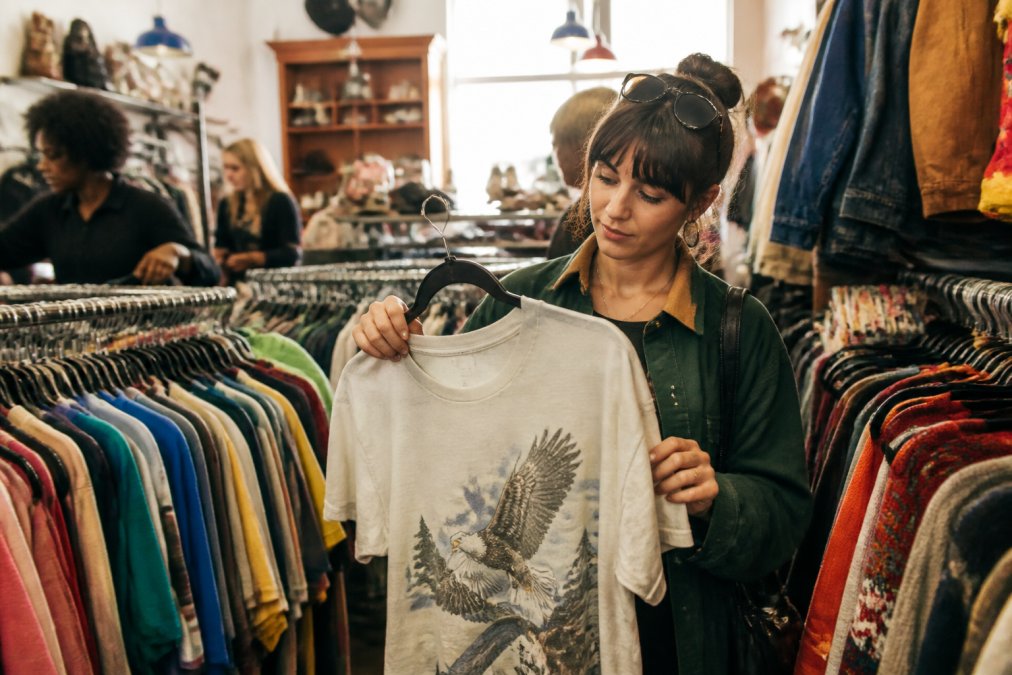
Thrifting is the single best budget lever for building an aesthetic wardrobe, because second-hand prices let you experiment without risk. The catch: thrift stores reward patience and knowledge, not speed. Go in with your palette and a list of gaps, not a vague hope of finding something good.
Reading a Fabric Label in Ten Seconds
The fastest quality check in any thrift store is the fiber-content tag, usually sewn into the side seam or back collar. Look for natural fibers listed first: cotton, linen, wool, silk, or rayon/viscose (a semi-synthetic made from wood pulp that drapes well and breathes better than polyester) (the FTC). "100% cotton" or "95% cotton, 5% elastane" is a green light; a tag dominated by polyester, acrylic, or nylon is a yellow flag, those fibers pill, hold odor, and trap heat, which matters at a concert. Blends aren't automatically bad: a little elastane adds stretch and shape retention, and wool blended with a synthetic can outlast pure wool. The rule: the higher the natural-fiber percentage, the longer the piece is likely to last.
The Three-Point Hand Test
Labels can be cut out or faded, so back up the tag with your hands. Squeeze the fabric and check three things. Weight: does it feel substantial, or papery and thin? Thin fabric wears through at stress points, elbows, knees, seat, within a season. Weave: hold it to light; a tight, even weave with no visible gaps outlasts a loose one. Recovery: stretch a small section and let go, good fabric snaps back, tired fabric stays stretched. Ten seconds per garment saves you from most mistakes that make thrifting feel like a gamble.
Spotting a Print That Will Survive the Wash
Graphic tees are the highest-risk thrift purchase, because a cracked or peeling print ruins an otherwise good shirt. Run a fingernail gently across the print: if it feels like a raised rubber layer on top of the fabric, it's a screen print that will eventually crack, especially if it's already stiff or flaking at the edges. If it feels smooth and integrated, or the color looks faded into the weave rather than sitting on top, it's likely a discharge or dye-based print that ages gracefully. A print bled through to the back usually signals heavier, better-applied ink.
What to Skip, Even at a Good Price
Some pieces aren't worth the thrift price no matter how cheap. Skip visible pilling under the arms or between the thighs, it doesn't reverse. Skip stretched-out collars and cuffs; ribbing that's lost its snap won't come back. Skip garments with a strong perfume or smoke smell that survives a sniff test, since those odors often live in synthetic fibers permanently. And skip anything needing more than one alteration, a $6 shirt plus $30 in tailoring is a $36 shirt.
Off-Season Timing and the Cost-Per-Wear Check
Off-season shopping works the same way as thrifting: buy the winter coat in spring, the summer pieces in fall, and let the discount do the work. Before any second-hand purchase, run the same cost-per-wear math you'd use on new items. A $15 thrifted wool coat you wear 40 times a winter is roughly 38 cents per wear. A $4 fast-fashion jacket you wear three times is $1.33 per wear, nearly four times more expensive. The thrift store isn't automatically the cheaper option; the piece you actually wear is. For guidance on textile labeling and care standards, the FTC's clothing care labeling guidance explains what those tags actually mean.
Fabric Quality Identification: How to Spot Pieces That Last
Fabric quality separates a wardrobe that lasts from one you replace every season, and it's learnable in an afternoon. Natural fibers like cotton, linen, and wool generally breathe better and age more gracefully than synthetics, though blends have their place for stretch and durability. Check three things: weight (substantial or papery?), weave (tight and even?), and finish (does the print or dye look like part of the fabric or sitting on top?).
Digital Closet Tools and the Psychology of Impulse Spending
Two things quietly wreck aesthetic wardrobes: forgetting what you own and buying on impulse. Digital closet apps solve the first by cataloging your clothes so you can see your whole wardrobe on your phone and plan outfits without digging. The second is psychological, impulse spending thrives on scarcity cues ("only 3 left!") and emotional spikes. The fix is a simple rule: wait 48 hours before any non-essential purchase. If you still want it two days later and it fits your palette, buy it; if not, you saved money and closet space. A wishlist plus a waiting period cuts impulse buys dramatically without killing the fun of browsing.
Conclusion: Your Aesthetic, Your Rules, Your Budget
Building an aesthetic wardrobe on a budget isn't about deprivation, it's about precision: knowing your palette, buying fewer better pieces, and letting one or two statement items do the heavy lifting. The challenge is finding pieces that express your fandom identity instead of generic merch everyone else is wearing. That's what Hot Takes Designs is built for. Every piece is custom-printed, cut, and sewn to order on ultra-soft fabrics with vibrant, long-lasting prints, in inclusive sizing from 2XS to 6XL. Get started with Hot Takes Designs and build a wardrobe that looks like you, not like everyone else.
Frequently Asked Questions
How do I figure out my clothing aesthetic without buying a bunch of new stuff?
Start with a wardrobe audit. Pull everything out of your closet and sort into three piles: love, maybe, and donate. The love pile reveals your actual aesthetic, not the one you think you should have. Take photos of your favorite outfits and look for patterns in color, silhouette, and texture. This costs nothing and gives you a clear direction before you spend a dime on new pieces.
What are the best ways to build a capsule wardrobe on a budget?
Focus on neutral colors and wardrobe staples that mix easily: solid tees, one good pair of jeans, a versatile jacket, and two pairs of shoes. Shop off-season sales and thrift stores for these core pieces. A capsule wardrobe on a budget works because every item pairs with at least three others. Add personality through accessories and graphic tees rather than buying more base layers.
How can I style graphic tees so they look intentional instead of sloppy?
Fit matters more than the graphic itself. Tuck the front hem slightly, add a structured layer like a denim jacket or blazer, and balance the silhouette with fitted bottoms. For a concert or fan event, layer a graphic tee under an open flannel or cropped hoodie. Roll the sleeves once or twice. These small moves turn a basic tee into a deliberate outfit without spending extra.
Is thrifting actually cheaper than buying new, or is that a myth?
Thrifting is cheaper for most wardrobe staples, especially denim, jackets, and accessories. The catch is consistency: you cannot walk in needing one specific item and always find it. Go with an open mind and a list of gaps in your closet. Second-hand shopping also lets you test a new aesthetic before committing real money. If you hate it, you spent five dollars instead of fifty.