

How to Find Your Aesthetic Style: A Step-by-Step Guide
Table of Contents
- Step 1: Audit Your Current Wardrobe Before You Find Your Aesthetic Style
- Step 2: Explore Aesthetic Types and Style Archetypes
- Step 3: Take a Personal Style Quiz to Narrow Your Focus
- Step 4: Build Style Mood Board Ideas That Actually Reflect You
- Step 5: Define Your Aesthetic Style in 3 Words
- Step 6: Build a Sustainable, Budget-Conscious Aesthetic Without Starting Over
- Step 7: Embrace Style Evolution, Transitioning Between Aesthetics
- Common Mistakes to Avoid When Finding Your Aesthetic Style
Last Updated: July 30, 2026
Most people approach finding their aesthetic style by scrolling Pinterest for hours, saving hundreds of images, and still feeling no closer to knowing what they actually want to wear. This guide from Hot Takes Designs cuts through that noise with a concrete, step-by-step framework that goes beyond generic style quizzes. You'll learn how to audit what you already own, decode your preferences, and build a visual identity that holds up across seasons and trends.
Here's what most guides get wrong: they treat aesthetic style like a fixed destination rather than a living, evolving practice. Your style is not a label you pick once. It's a language you develop.
Step 1: Audit Your Current Wardrobe Before You Find Your Aesthetic Style
Pull everything out. The wardrobe audit is the most underrated step in the entire process, and skipping it is why so many people end up with closets full of impulse buys that never get worn.
Lay your clothes out by category: tops, bottoms, outerwear, shoes, accessories. Then sort each item into one of three piles.
Keep: You reach for it consistently, it fits well, and you feel like yourself when you wear it.
Toss (or donate): It hasn't been worn in over a year, it no longer fits your body or your life, or you only kept it out of guilt.
Question: You like it in theory but never actually wear it. These items reveal your real patterns.
The "Question" pile is where your real data lives. Look for patterns. Are they all a specific color you thought you hated? A silhouette you bought because it was trendy? Items that represent an aspirational version of yourself rather than who you actually are today?
According to The Psychology of Fashion and Self-Expression, the clothes we choose to wear are deeply tied to self-concept and identity formation. What you avoid wearing tells you just as much about your aesthetic identity as what you reach for every morning.
What to Keep, Toss, and Question
| Pile | Criteria | Action |
|---|---|---|
| Keep | Worn regularly, fits well, feels authentic | Organize by color and silhouette |
| Toss | Not worn in 12+ months, no longer fits | Donate, sell, or recycle |
| Question | Like it in theory, rarely worn | Photograph and analyze for patterns |
A curated closet with 30 pieces you love will always outperform a bloated wardrobe with 200 items you feel neutral about.
Step 2: Explore Aesthetic Types and Style Archetypes
Forget the idea that you need to pick one aesthetic and commit to it forever. Aesthetic types are reference points, not personality tests. The most interesting personal style usually pulls from two or three overlapping archetypes rather than sitting neatly inside one box.
The most commonly referenced style archetypes include: Classic, Romantic, Dramatic, Natural, Gamine, and Creative. These categories, rooted in fashion psychology, describe not just what you wear but how you relate to clothing as a form of self-expression.
From Balletcore to Grungecore: Navigating 'Core' Culture Without Burning Out
Micro-aesthetics have exploded in recent years. Balletcore, grungecore, cottagecore, dark academia, coastal grandmother: every few months, a new "core" takes over social media and suddenly everyone feels pressure to adopt it.
The problem with chasing cores is aesthetic fatigue. You invest in a wardrobe built around one micro-trend, the trend fades, and you're left with a closet that feels like a costume rather than a reflection of who you are. The smarter approach is to identify which cores genuinely resonate with your existing preferences and extract their underlying principles rather than copying them wholesale.
Balletcore appeals to people drawn to soft silhouettes, muted palettes, and structured femininity. Grungecore resonates with those who want visual tension, layering, and a rejection of polish. Neither requires a full wardrobe overhaul. One well-chosen piece can communicate the essence of an aesthetic without locking you into it.
The Anti-Aesthetic Approach: When No Label Fits
Some people simply do not fit neatly into any existing aesthetic category. This is not a problem to solve. It's actually a signal worth paying attention to.
The anti-aesthetic approach is a deliberate rejection of label-based dressing in favor of building a visual identity around principles rather than references. Instead of asking "what aesthetic am I?" you ask: What textures do I consistently reach for? What silhouettes make me feel most like myself? What do my favorite outfits have in common? This approach produces the most durable personal style because it's built from the inside out.
Step 3: Take a Personal Style Quiz to Narrow Your Focus
A personal style quiz works best as a starting point, not a verdict. The goal is to surface patterns in your preferences that you might not have consciously noticed, not to hand you a label and call it done.
Here's a simplified self-quiz you can run right now:
- When you feel most like yourself, are you dressed in something structured or relaxed?
- Do you prefer your clothing to blend in or stand out in a room?
- Is your color comfort zone built around neutrals, brights, or deep/dark tones?
- Do you gravitate toward minimal layering or building complex outfits?
- Is your priority comfort, visual impact, or both equally?
- Do you prefer your clothes to feel timeless or current?
- How much of your wardrobe is driven by your fandoms, interests, or community identity?
Your answers will give you a set of non-negotiables that any aesthetic you explore should accommodate.
Step 4: Build Style Mood Board Ideas That Actually Reflect You
A mood board is not a collection of things you wish you could afford. A style mood board captures the visual feeling you want your wardrobe to produce: textures, color relationships, silhouette shapes, and the overall emotional register of the looks that resonate with you.
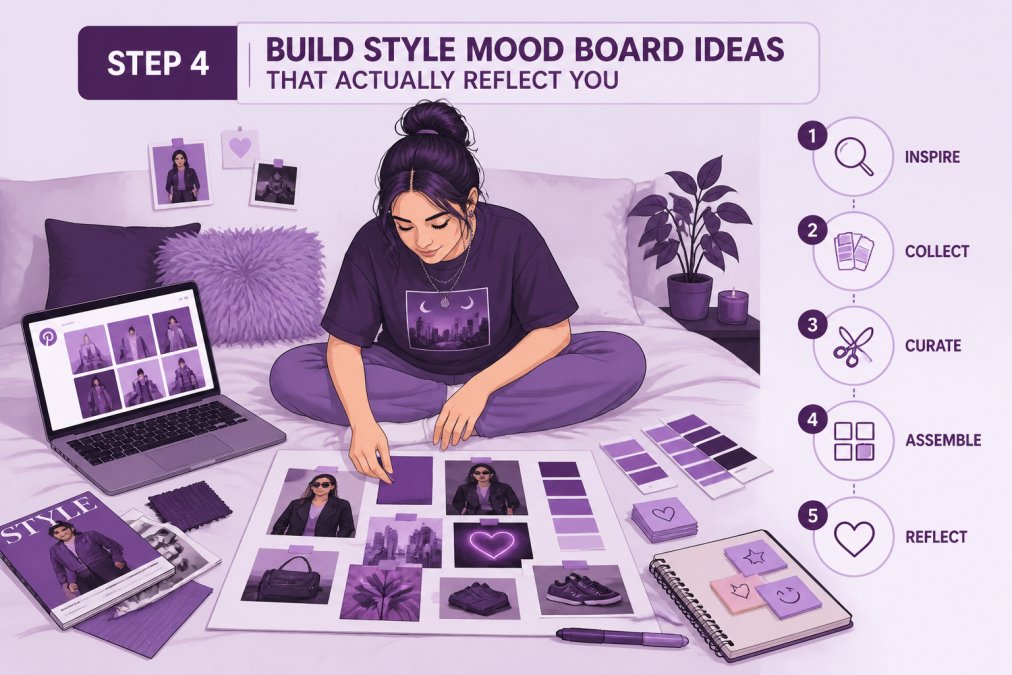
Start by saving images without filtering yourself. Spend 20 minutes pulling any image that creates a strong reaction. Then, once you have 50 to 80 images, step back and look for the patterns.
According to Visual Identity and Consumer Self-Expression Research, people consistently underestimate how much their visual preferences reveal about their deeper values and personality structures.
Identifying Your Style Icons and Color Palette
Style icons are most useful when you analyze why a specific look works rather than trying to copy it wholesale. Choose three people whose style consistently resonates with you. For each icon, identify the dominant silhouettes they favor, their relationship to color, and how much visual complexity they work with in a single outfit.
Your color palette is one of the most powerful tools in your style toolkit. Most people's natural color instincts cluster around two or three families. Identifying your instinctive palette means you can build a capsule wardrobe where everything works together without planning every outfit in advance.
Step 5: Define Your Aesthetic Style in 3 Words
Defining your aesthetic style in 3 words is one of the most practical frameworks for making consistent wardrobe decisions. Three words is the sweet spot: specific enough to be useful, broad enough to allow variety.
Your three words should describe the feeling your style produces, not the specific items in your wardrobe. "Structured, dark, and tactile" is more durable than "blazers, black, and velvet" because it survives trend cycles and can be expressed through many different pieces over time.
To find your three words, look at your mood board and your "Keep" pile from the wardrobe audit. Try these categories:
- Energy: calm, bold, playful, sharp, soft, restless
- Texture/Materiality: polished, raw, layered, clean, worn-in
- Social signal: understated, expressive, niche, accessible, statement-making
Write your three words somewhere visible while you shop or plan outfits. When you're considering a new piece, ask whether it genuinely fits all three.
Using Silhouettes and Shapes to Lock In Your Visual Identity
Silhouette is the single most underrated element of personal style. Your silhouette preferences tend to be consistent even when everything else changes. Recognizing your silhouette instincts means you can shop faster, make fewer mistakes, and build a more cohesive curated closet.
The most useful silhouette framework groups shapes into three relationships: volume on top with fitted bottoms, fitted on top with volume on the bottom, and balanced volume throughout. Most people have a strong preference for one of these.
Step 6: Build a Sustainable, Budget-Conscious Aesthetic Without Starting Over
The biggest myth in personal style is that finding your aesthetic requires a complete wardrobe overhaul. It doesn't. The most sustainable approach is additive: identify the gaps in your existing wardrobe relative to your three words, and fill them deliberately rather than reactively.
A sustainable aesthetic-building process looks like this:
- Define your three words and your core silhouette preference
- Identify the 5 to 10 pieces in your current wardrobe that best express those words
- List the specific gaps: what types of pieces are missing?
- Set a monthly "one intentional piece" budget rather than a seasonal splurge budget
- Prioritize secondhand and resale markets for trend-adjacent pieces, reserve new purchases for core wardrobe staples
Brands like Hot Takes Designs make this easier for people whose aesthetic identity is tied to specific fandoms or communities. Made-to-order graphic apparel means you're not buying inventory that might not reflect your actual niche: you get the specific design that fits your identity without the waste of mass-produced alternatives.
Step 7: Embrace Style Evolution - Transitioning Between Aesthetics
Your aesthetic style will change. This is not a failure of self-knowledge. It's evidence that you're paying attention.
The most common trigger for aesthetic transition is a life change: a new city, a new community, a shift in values, or simply growing out of a phase that no longer fits. A smarter transition process works in layers:
- Identify which elements of your current aesthetic you still love and want to carry forward
- Identify the specific qualities of the new direction that appeal to you
- Find the overlap between the two, and start there
- Add new pieces gradually while retiring old ones as they wear out naturally
As documented in Fashion Psychology and Identity Transition Research, style transitions are most successful when they're treated as evolution rather than replacement.
Body Neutrality and Style: Dressing for Who You Are Right Now
Body neutrality is the practice of relating to your body based on what it does rather than how it looks. Applied to personal style, it means building your wardrobe around your actual body right now, not a future version of your body you're working toward.
Clothes that fit your current body will always look better than clothes that fit an aspirational size. Hot Takes Designs addresses this directly with sizing that runs from 2XS to 6XL, with patterns graded for actual fit rather than just scaled up, which matters enormously for anyone who has been burned by extended sizing that doesn't actually account for proportional differences.
Common Mistakes to Avoid When Finding Your Aesthetic Style
Confusing inspiration with aspiration. Your mood board should reflect your actual preferences, not your fantasy self.
Treating aesthetic style as a fixed destination. Style evolves. Locking yourself into a label too rigidly means you'll feel like you're "breaking the rules" every time your preferences shift.
Buying for the aesthetic rather than the outfit. Every new piece should connect to at least three existing items in your wardrobe.
Ignoring the role of context. Your aesthetic style needs to function across your actual life: work, social events, casual days, and the specific communities you're part of.
Skipping the audit. Without the wardrobe audit, you're building on an unstable foundation. The audit is where your real preferences reveal themselves.
According to Sustainable Fashion and Consumer Behavior Research, Americans generate a significant volume of textile waste annually, much of it driven by trend-chasing purchases that don't integrate into existing wardrobes. Building a deliberate, values-aligned aesthetic is one of the most effective ways to break that cycle.
| Common Mistake | Root Cause | Fix |
|---|---|---|
| Buying trend pieces impulsively | Chasing cores without a filter | Test against your 3 words first |
| Wardrobe doesn't feel cohesive | No silhouette or color framework | Audit and identify your visual anchor |
| Aesthetic fatigue after 6 months | Treated style as a destination | Build from principles, not labels |
| Extended sizes that don't fit right | Brands scaling without grading | Seek brands that grade patterns by size |
| Mood board doesn't match real wardrobe | Aspirational vs. actual preferences | Save only what you'd actually wear |
Style is not something you find once and keep forever. It's something you build, refine, and update as you grow. The framework above gives you the tools to do that deliberately rather than reactively, so your wardrobe actually works for your life instead of against it.
Building a genuine aesthetic identity takes more than a Pinterest board and a style quiz. The real work is in the audit, the three words, and the deliberate choices that follow. Hot Takes Designs was built for people who already know what they're about: fans, creators, and individuals who want apparel that reflects their actual identity rather than generic streetwear. With custom-printed, made-to-order pieces in sizes from 2XS to 6XL and designs built specifically for K-Pop, BookTok, and graphic streetwear communities, the collection is designed to slot into a curated wardrobe rather than replace one. View all designs at Hot Takes Designs and find the pieces that actually fit your three words.
Frequently Asked Questions
What are the different aesthetic types and how do I know which one fits me?
Aesthetic types range from softcore categories like balletcore, cottagecore, and dark academia to streetwear-rooted styles like grungecore and Y2K. To find your fit, pay attention to which outfits make you feel most like yourself, not just what looks good on a screen. A wardrobe audit combined with a personal style quiz can help you spot patterns in what you actually reach for versus what sits unworn. Your aesthetic style doesn't have to match a single label to be valid.
What is the 3-word method for finding your aesthetic style?
The 3-word method asks you to define your style in 3 words, descriptors that capture your mood, energy, and visual identity together. For example: 'bold, moody, graphic' or 'soft, romantic, minimal.' These three words act as a filter when shopping or curating your wardrobe: if a piece doesn't match at least two of your three words, it probably doesn't belong. It's a practical shortcut that cuts through aesthetic fatigue and keeps your wardrobe curation intentional rather than impulsive.
How do I create a mood board for my aesthetic style?
Start by saving images that make you feel something, outfits, color palettes, interiors, even album artwork. Use Pinterest or a physical board with magazine cutouts. Look for patterns: recurring colors, silhouettes, textures, or vibes. Your mood board doesn't need to be all fashion; lifestyle images often reveal your aesthetic identity more honestly than outfit photos alone. Once you spot three or more recurring themes, those become the foundation of your style mood board and your personal style direction.
How can I incorporate my fandom or interests into my aesthetic style?
Fandom identity and personal style overlap more naturally than most people think. If you're a K-Pop fan or part of the BookTok community, your interests can anchor your entire visual identity, through graphic tees, color palettes pulled from your favorite album art, or accessories that nod to your fandom without being costume-level obvious. The key is finding pieces that feel like self-expression, not just merch. Look for apparel that blends your fandom with your existing aesthetic so outfits feel cohesive and genuinely yours.
Is it okay to switch aesthetics, or does my style need to stay consistent?
Style evolution is completely normal and actually signals a healthy relationship with fashion. Aesthetic fatigue, that burned-out feeling after over-committing to one 'core', is real, especially in the age of TikTok micro-trends. Transitioning between aesthetics doesn't mean you lack a fashion identity; it means your identity is growing. The goal is style consistency in terms of how clothes make you feel, not rigid loyalty to a single label. Build a capsule wardrobe of versatile pieces that can flex across multiple aesthetics as you evolve.
This article was written using GrandRanker