

Alternatives to Fast Fashion Graphic Tees
Table of Contents
- Why Fast Fashion Graphic Tees Fall Apart
- How to Spot Fast Fashion in Graphic Apparel
- What Makes Sustainable Streetwear Brands Different
- Custom-Printed Tees Built for Longevity
- Fabric Quality and Print Durability Matter
- Building a Capsule Wardrobe With Statement Graphic Tees
- Frequently Asked Questions
Last Updated: September 20, 2026
Why Fast Fashion Graphic Tees Fall Apart
Fast fashion graphic tees are designed to fail. The entire model depends on it. You buy a cheap tee, wear it a handful of times, and the print cracks. The fabric pills. The fit warps. Then you toss it and buy another one. That's the business model, planned obsolescence dressed up as affordability.
Fast fashion brands optimize for cost per unit shipped: thin cotton blends, poor print bonding, and fraying seams. You're paying for disposability, not durability.
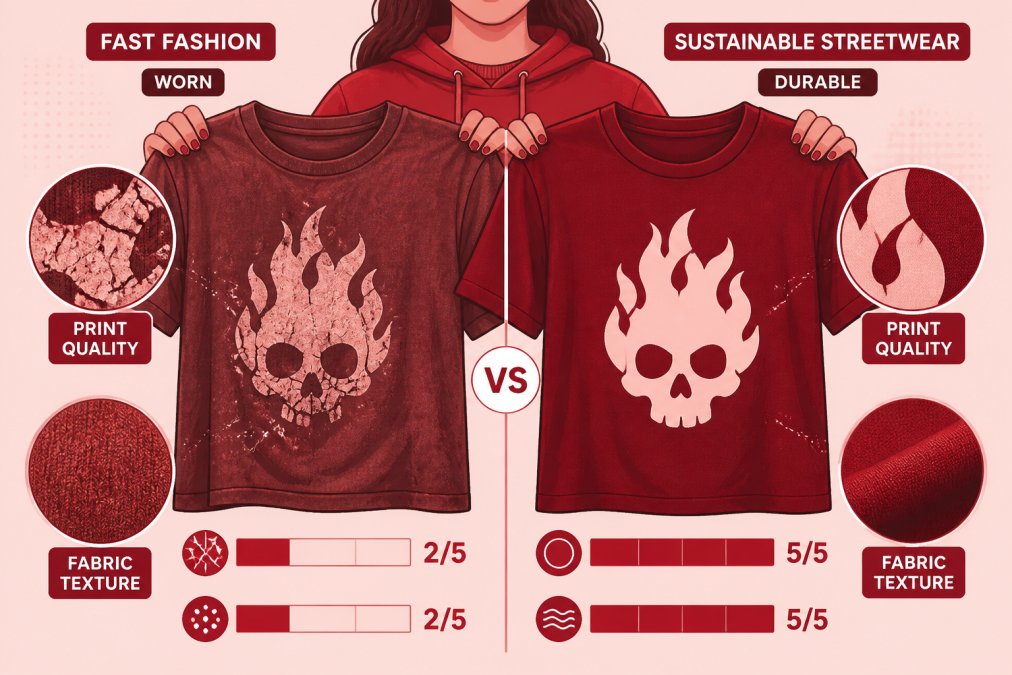
Graphics peel within 3-5 washes, necklines stretch, and colors fade unevenly. By month two, you're buying again, the cycle that keeps fast fashion profitable.
The real cost is replacement: five cheap tees yearly costs more than two quality pieces lasting three years, plus environmental waste.

How to Spot Fast Fashion in Graphic Apparel
Identifying fast fashion requires understanding how shirts behave over time, not just initial feel or price.
Fabric Weight and Fiber Content
Fast fashion uses 4-ounce cotton or lighter, often polyester-blended. Quality tees start at 4.2 ounces and reach 5.3 ounces, noticeably thicker and more durable. Ultra-light fabrics pill after 10-15 washes. Look for "combed ring-spun cotton" or "organic cotton" on labels; these longer fibers resist pilling and maintain softness.
Print Durability Indicators
Press your fingernail against the print: if it feels plasticky and raised, it's fast fashion. Quality screen printing bonds ink into fibers; cheap printing sits on the surface and cracks within 5-10 washes. Fuzzy print edges indicate cheap printing; crisp edges suggest proper curing. Fast fashion uses plastisol inks that harden and crack with wear.
Seam Construction
Fast fashion uses single-needle stitching that frays after a few washes. Quality uses double-needle stitching and taped shoulders. Check neckline binding: cheap brands use thin, single-layer binding that stretches; quality brands use reinforced binding.
Label Transparency and Care Instructions
Detailed care instructions, "Turn inside out," "Wash cold," "Tumble dry low", indicate confidence in durability. Vague guidance suggests the brand knows the shirt won't survive normal washing. Manufacturing in countries with established quality standards (Portugal, Japan, Europe) typically indicates higher quality control.
Price as a Signal, Not a Rule
Graphic tees under $20 are almost always fast fashion; quality materials, proper printing, and fair labor have real costs. Price over $30 doesn't guarantee quality. Look at the combination of price, fabric weight, seam quality, and print durability.
The Durability Test You Can't Do in a Store
After 20+ washes, fast fashion shows degradation: cracked prints, stretched necklines, dull colors, pilled fabric. Quality tees maintain shape and vibrancy. Look for brands offering detailed wash guides, shrinkage-adjusted sizing charts, and solid return policies, signs of confidence in durability.
What Makes Sustainable Streetwear Brands Different
Sustainable brands operate on a different philosophy: creating pieces people want to keep wearing, not maximizing profit per unit.
Sustainable brands invest in organic cotton and ring-spun fibers designed for longevity. These materials cost more but perform better and improve with wear instead of degrading.
Custom-printed brands print on demand, eliminating overproduction, the biggest source of textile waste. No excess inventory, no clearance sales driving disposable consumption.
Sustainable brands use double-needle stitching, taped shoulders, and side-seamed construction, details that cost more but ensure seams won't split and necklines won't stretch after 50 washes.
Quality brands use screen printing or advanced direct-to-garment methods that bond properly to fabric. Graphics won't crack, peel, or fade unevenly after a year of wear.
Sustainable brands offer extended sizing with properly graded patterns for different body types, not just scaled-up versions. This improves fit and how graphics look on your body.
Custom-Printed Tees Built for Longevity
How Made-to-Order Changes Production Quality
Fast fashion forecasts demand and produces thousands of units, pressuring brands to cut corners. Custom-printed tees flip this: production happens after purchase, eliminating pressure to cut costs and removing the financial incentive to compromise on quality.
Made-to-order production lets brands invest in premium materials without overproduction risk. Costs are passed to committed customers, which is why custom brands consistently use higher-quality blanks.
Printing Methods and Durability
Custom printing typically uses methods that prioritize longevity over speed.
Fast fashion brands often use cheap direct-to-garment or low-quality screen printing with plastisol inks that harden into a plastic layer. This creates visible cracking within 5-10 washes as the shirt flexes and the hardened ink layer breaks. Custom brands investing in durability use either proper screen printing or premium DTG inks with appropriate curing times, both methods that prioritize longevity over speed.
The Independent Artist Angle
Fast fashion graphic tees feature mass-produced clip art or generic designs with profits flowing to the brand. Custom-printed tees often feature independent artists who retain creative control and earn per-unit royalties.

This distinction matters for both ethics and design quality. Independent artists create more original, thoughtful graphics because their reputation and income depend on quality. They're not optimizing for trend cycles or lowest-cost production. They're building a body of work and a following. The designs tend to age better because they're not chasing fleeting trends. A vintage-inspired illustration or bold typographic statement from an independent artist remains relevant years later, while a mass-produced meme reference feels dated within months.
Sustainability Through Elimination of Waste
Custom printing produces zero overproduction waste. You're not manufacturing extras that end up as landfill. You're not overproducing hoping some will sell. The environmental impact per garment is dramatically lower than fast fashion, even accounting for individual shipping.
The Longevity Equation
A custom-printed tee delivers better value than fast fashion tees that fail within three months. The per-wear cost is dramatically lower. More importantly, the emotional relationship to the piece changes. A custom tee feels like something worth keeping, worth caring for, worth wearing repeatedly. That psychological shift from disposable to intentional is what actually drives longevity.
Fabric Quality and Print Durability Matter
The difference between a tee that lasts and one that falls apart comes down to two factors: what it's made of and how the graphic is applied.
Fabric quality starts with fiber content. Premium tees use 100% combed ring-spun cotton or cotton-blend fabrics. Combing removes short fibers, leaving longer ones that create a softer, more durable yarn. Ring-spun processing twists fibers together in a way that increases strength. The result is fabric that withstands repeated washing without pilling or degradation.
Fabric weight matters too. Quality tees typically weigh 4.2 to 5.3 ounces per square yard. This range provides the sweet spot between comfort and durability. Anything lighter starts feeling cheap. Anything heavier becomes uncomfortable for everyday wear. The best brands nail this balance.
Print durability depends on the method and the ink. Quality brands produce prints that survive without cracking or fading.
The care instructions matter too. Brands that stand behind their quality provide detailed washing guidance. Turn the shirt inside out. Wash cold with similar colors. Tumble dry low or hang dry. These aren't suggestions, they're the conditions under which the shirt will maintain its appearance. Cheap brands hide behind vague instructions because they know their products won't survive normal washing.
Building a Capsule Wardrobe With Statement Graphic Tees
A capsule wardrobe is the opposite of fast fashion. Instead of buying constantly, you curate a small collection of pieces that work together. Statement graphic tees are perfect for this approach because they're versatile and expressive.
Start by choosing a color palette. Neutral bases, black, white, gray, cream, pair with almost everything.
| Approach | Cost Per Tee | Lifespan | Total Cost Over 3 Years | Sustainability |
|---|---|---|---|---|
| Fast Fashion (5 per year) | $15 | 3-5 months | $225 | High waste |
| Mid-Range Quality (2 per year) | $25 | 1-2 years | $75 | Moderate waste |
| Premium Custom (1 per year) | $30 | 3+ years | $90 | Minimal waste |
Frequently Asked Questions
What's the difference between fast fashion graphic tees and sustainable alternatives?
Fast fashion graphic tees use thin fabrics, low-quality prints that crack after a few washes, and overseas production with minimal oversight. Sustainable alternatives use premium cotton blends, durable printing methods like direct-to-garment or screen printing, and transparent manufacturing. The prints last 50+ washes instead of 5-10, and the fabric holds its shape and softness through regular wear.
How can I tell if a clothing brand is fast fashion?
Watch for ultra-low prices (under $15), vague fabric descriptions, no care instructions, and production timelines that suggest mass inventory. Fast fashion brands push new designs weekly and rarely disclose where or how garments are made. Ethical brands provide detailed fabric content, manufacturing location, and fair labor practices. If a brand won't tell you where it's made, that's a red flag.
Are sustainable graphic tees more expensive?
Yes, but the math changes when you factor in durability. A $15 fast fashion tee lasts 5-10 washes before the print cracks or fabric fades. A sustainable tee from brands using premium combed cotton and professional printing lasts longer. You're paying once for quality instead of replacing cheap tees every few months. Custom-printed options cost more upfront but deliver unique designs you won't find anywhere else.
What fabric should I look for in a long-lasting graphic tee?
Look for 100% combed ring-spun cotton or cotton-blend fabrics (4.2 oz/yd² or heavier). Combed cotton is softer and more durable than standard cotton. Avoid thin, synthetic-heavy blends. For print longevity, verify the brand uses quality printing methods rather than cheap heat transfer. Check care instructions: brands that recommend cold washing and low-heat drying are protecting both fabric and print quality.
The choice isn't between fast fashion and premium pricing. It's between constant replacement and actual ownership. Hot Takes Designs offers custom-printed apparel with ultra-soft fabrics and vibrant prints designed to last. Every tee is made to order using quality materials, so you get exactly what you want without the waste. View all and start building a wardrobe that actually reflects who you are.