

Organic Cotton vs Polyester Graphic Tees: 2026 Guide
Table of Contents
- Why Organic Cotton vs Polyester Matters for Graphic Tees
- Organic Cotton vs Polyester: Head-to-Head Comparison Table
- Comfort, Breathability, and Moisture-Wicking Performance
- Screen Printing on Cotton vs Polyester: Which Holds a Graphic Better?
- Cotton Polyester Blend T-Shirts: The Middle Ground
- The Best Material for Graphic Tees by Use Case
- How to Wash Graphic Tees to Keep Prints and Fabric Intact
- Conclusion: Picking Your Fabric Without the Guesswork
- Frequently Asked Questions
Last Updated: October 13, 2026
Why Organic Cotton vs Polyester Matters for Graphic Tees
The organic cotton vs polyester decision shapes everything about a graphic tee: how it feels against your skin, how long the print survives, and how the shirt behaves after fifty washes. At Hot Takes Designs, we print on 100% cotton blanks for exactly this reason. Get the fabric wrong and you're wearing a wrinkled, cracked mess by month two.

Here's the part most buyers never hear. Fabric composition decides whether your favorite design stays sharp or fades into a ghost of itself. Cotton takes screen printing and direct-to-garment inks beautifully. Polyester needs specialty dyes or the graphic slides right off in the wash. That single fact drives most of what follows.
Below, we'll break down comfort, print durability, care, and cost per wear so you can stop guessing and start choosing.
Textile Exchange Materials Market Report
Organic Cotton vs Polyester: Head-to-Head Comparison Table
Here's the short version before we get into the weeds.
| Factor | Organic Cotton | Polyester | Cotton-Poly Blend |
|---|---|---|---|
| Breathability | High | Low | Medium |
| Moisture handling | Absorbs, slow dry | Wicks, fast dry | Mixed |
| Softness over time | Gets softer | Stays slick | Stays consistent |
| Shrinkage risk | Moderate | Minimal | Low |
| Print compatibility | Excellent | Tricky | Good |
| Biodegradability | Yes | No | Partial |
The trade-off is simple: cotton wins on comfort and print quality, polyester wins on wrinkle resistance and quick drying.
Comfort, Breathability, and Moisture-Wicking Performance
Cotton is the more comfortable choice for everyday wear, and it's not close. Natural fibers breathe, letting airflow move through the weave so heat escapes instead of trapping against your back.
Polyester does the opposite. It's a synthetic fiber that holds heat, which is why a polyester tee can feel clammy after twenty minutes in the sun. The one place polyester pulls ahead is moisture-wicking. It pushes sweat to the surface and dries fast, which matters for performance wear and gym sessions.
For a concert, a fan event, or a BookTok filming day, cotton's breathability wins. You're standing, dancing, and sweating under lights, not running a 5K.
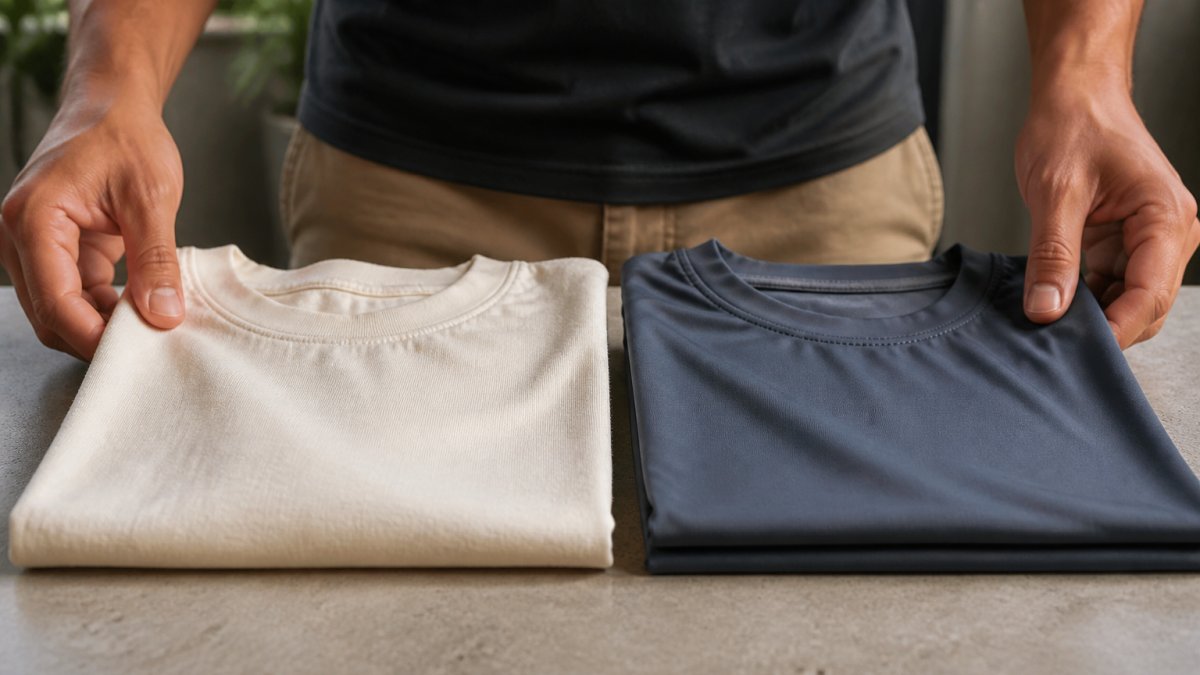
Screen Printing on Cotton vs Polyester: Which Holds a Graphic Better?
Print durability is where the organic cotton vs polyester choice stops being about feel and starts being about whether your graphic survives past wash ten. The short answer: cotton holds ink better, polyester holds it differently, and the printing method matters as much as the fiber.
Here's how each method actually behaves on each fabric.
Screen printing (plastisol and water-based inks). Plastisol ink sits on top of the fabric and cures under heat. On cotton, the ink mechanically locks into the fiber's surface texture and forms a flexible film that stretches with the shirt.
Direct-to-garment (DTG). DTG printers lay down a water-based pretreatment, then jet white ink and CMYK on top. Cotton absorbs the pretreatment and the ink sits in the fiber, so the print feels soft and survives repeated laundering. Polyester needs a different pretreatment chemistry, and without it the ink tends to sit on the surface, crack along fold lines, and fade faster. This is why most DTG shops quote cotton and cotton-rich blends first.
Direct-to-film (DTF). DTF transfers a printed film onto the garment with a heat press. It works on both cotton and polyester, and on blends, because the adhesive bonds to the surface rather than the fiber. The trade-off is hand feel: DTF sits on top of the shirt, so it feels slightly rubbery on cotton and can look glossy on polyester.
Sublimation. Sublimation only works on polyester or on garments with a polyester coating, because the dye has to turn to gas and bond with the polymer. On 100% organic cotton, sublimation does not work at all, the dye has nothing to bond to. This is the single biggest print-method limitation in the whole comparison, and it's the reason performance and all-over-print apparel is almost always polyester.
What organic certification changes, and what it does not. Organic certification (USDA Organic, GOTS) governs how the cotton fiber was grown and processed. It does not change how cotton behaves under a screen, a DTG head, or a heat press. A GOTS-certified cotton tee and a conventional cotton tee print essentially the same way.
Wash durability, in practice. A common pattern in print shops: a properly cured plastisol print on 100% cotton holds color and adhesion through dozens of home launderings with minimal cracking. The same print on polyester is more likely to show dye migration, edge lift, or a dulled appearance sooner, especially if the shirt is washed warm or dried on high.
Cotton Polyester Blend T-Shirts: The Middle Ground
Cotton polyester blend T-shirts split the difference, and for some people that's the right call. A 50/50 or 60/40 blend resists shrinking and wrinkling better than pure cotton while keeping some of the natural softness.
The catch is print quality. Blends land between cotton and polyester for ink adhesion, so graphics hold up reasonably well but rarely as long as they do on 100% cotton. If you want the crispest, most durable print, cotton still wins.
Blends make sense for heavy rotation basics. They make less sense for a statement graphic tee you actually care about.
"Guilty As Charged" Graphic T-Shirt | Sarcastic Humor Unisex Classic Tee →
The Best Material for Graphic Tees by Use Case
The best material for graphic tees depends on what you're doing in them. Match the fabric to the job:
- Concerts and fan events: 100% cotton for breathability and print longevity
- Gym and workouts: Polyester or a performance blend for moisture-wicking
- Everyday streetwear: Cotton or a light blend for softness and shape retention
- Layering pieces: Midweight cotton holds structure under a jacket
- Gifts and fandom merch: Cotton, because the print is the whole point
Our Stray Kids SKZOO tee is built on 100% cotton with double-sided DTF printing, so both the front and back graphics stay vivid. That's the fabric choice doing its job.

How to Wash Graphic Tees to Keep Prints and Fabric Intact
Care is where the organic cotton vs polyester decision gets tested every week. The same wash cycle that keeps a cotton tee soft can crack a print, shrink a hem, or send polyester microfibers into the wastewater stream. Here's what actually happens, and how to slow it down.
Temperature is the biggest lever. Heat does two things to a graphic tee: it relaxes cotton fibers (which is why a hot wash plus a hot dryer shrinks a cotton tee and distorts the shoulders), and it stresses the ink-to-fabric bond. Cold water, around 60-80°F from most household taps, cleans a graphic tee fine and is the single easiest way to extend print life.
Detergent choice matters more than people think. Powder detergents can leave residue that dulls a print, and detergents with built-in fabric softener or optical brighteners coat the fibers. On cotton, that coating can make the print look hazy over time. On polyester, softener residue is a known contributor to that slick, slightly greasy feel.
Inside-out, gentle cycle, and don't overload. Turning the shirt inside out protects the print from abrasion against zippers, buttons, and other garments. A gentle or delicate cycle reduces the mechanical agitation that cracks plastisol and lifts DTF edges. Overloading the drum increases friction, another quiet cause of print wear.
Drying is where most prints die. High heat in a dryer is the leading cause of cracked plastisol and shrunken cotton. Tumble dry low is the compromise; hang drying or laying flat is better. If you hang dry, hang by the hem or lay flat rather than hanging by the shoulders, which can stretch a wet cotton neckline.
Ironing and storage. Never iron directly over a print, use a pressing cloth or iron the shirt inside out. For storage, folding is gentler than hanging for heavy cotton tees, and keeping shirts out of direct sunlight slows fading on both cotton and polyester prints.
The microfiber-shedding angle. Every wash of a synthetic garment releases microfibers into the water supply, and polyester graphic tees are no exception. Research on microfiber pollution has focused on fleece and athletic wear, but the mechanism applies to any polyester knit: mechanical agitation in the wash breaks off tiny plastic fibers that pass through most wastewater treatment.
A realistic wash-test expectation. A common pattern reported by print shops and home testers: a properly cured screen print on 100% cotton, washed cold and dried low, holds up for dozens of cycles with only minor softening. The same print on polyester tends to show dye migration or edge lift sooner.
FTC Green Guides on environmental marketing claims
Conclusion: Picking Your Fabric Without the Guesswork
Fabric choice is a decision you make once and live with for years. Cotton gives you comfort, breathability, and prints that survive the wash cycle. Polyester gives you quick-drying performance at the cost of print durability. Blends sit in the middle.
At Hot Takes Designs, we print on ultra-soft cotton blanks and build every piece to order, so your graphic stays vibrant and your fit feels right. Explore our full collection and find a tee made for your fandom.
FTC Green Guides on environmental marketing claims
Frequently Asked Questions
Is cotton or polyester better for graphic tees?
It depends on how you wear the tee and what print method was used. Organic cotton wins on breathability, softness, and how well it takes screen-printed and DTG graphics, which is why 100% cotton tees like the Stray Kids SKZOO Double-Sided DTF T-Shirt ($32.06) are common for concert and everyday wear. Polyester holds vivid dye-sublimation color and resists wrinkling, but it traps heat and can feel slick against skin. For most graphic tees worn casually, cotton or a cotton-rich blend is the safer pick.
Do graphic prints look better on organic cotton or polyester?
Print method matters more than fiber alone. Screen printing and direct-to-garment (DTG) inks bond best to cotton, giving crisp detail and a soft hand-feel. Polyester needs dye-sublimation for a permanent, bleed-free result because plastisol inks do not adhere well to synthetic fibers. If you want a graphic that resists cracking on a cotton tee, look for double-needle stitched hems and taped neck and shoulders, like the "Guilty As Charged" Graphic T-Shirt ($27.54), and always wash cold and inside-out.
How do you wash organic cotton and polyester graphic tees?
Turn the tee inside out, machine wash cold with like colors, and skip bleach or fabric softener, which break down print adhesives. Tumble dry low or hang dry to protect both the fabric and the graphic. Hot water and high heat are the two biggest causes of shrinkage on cotton and cracking on prints. Following these steps keeps organic cotton tees soft and polyester tees wrinkle-free for far more wash cycles.
Is 60% cotton 40% polyester good for summer?
A 60/40 cotton-polyester blend is a reasonable summer option if you want less wrinkling and faster drying than pure cotton. The trade-off is breathability: polyester traps more heat, so a blend feels warmer in humid conditions than 100% cotton. For hot concert days or outdoor events, a lightweight 100% cotton tee like the Miss Spookentina Graphic T-Shirt ($35.00, 4.2 oz/yd²) breathes better. If sweat and quick-dry matter most, a blend works fine.
Do polyester graphic tees hold their shape better than cotton tees?
Polyester resists stretching and shrinking more than cotton, so it tends to keep its original shape longer, especially after repeated washing. Cotton can shrink slightly and relax at the neckline over time unless it has taped neck and shoulder seams and double-stitched hems to reinforce the structure. If shape retention is your priority, a polyester or cotton-poly blend is the more durable choice, though it will feel less breathable than a 100% cotton tee.