

Fold Graphic Tees Without Creases: The Right Way
Table of Contents
- Why Your Graphic Tees Get Creased (And Why the Print Matters)
- What You'll Need Before You Start Folding
- Step-by-Step: How to Fold Graphic Tees to Prevent Creases
- Hanging vs Folding Graphic Tees: Which One Saves Your Print?
- How to Remove Creases from Graphic Tees Without Damaging the Print
- The Best Way to Fold T-Shirts for Travel (Without Wrinkles)
- Fabric-Specific Folding: Cotton Jersey vs. Blends vs. Vintage Prints
- Long-Term Storage Solutions for Graphic Tee Collections
- Frequently Asked Questions
Last Updated: October 3, 2026
Why Your Graphic Tees Get Creased (And Why the Print Matters)
The best way to fold graphic tees to prevent creases is to fold along the seams, keep the printed area flat, and never let a hard fold cross the graphic.

Here's the thing most people miss: the crease itself isn't the real problem. The damage is.
A graphic tee is a cotton shirt with a printed design bonded to the fabric surface. The ink sits on top of the fibers, not inside them.
That's why a graphic tee needs different handling than a plain one. Keep reading and we'll show you exactly how to fold graphic tees so the print stays sharp.
American Cleaning Institute fabric care guidance
What You'll Need Before You Start Folding
You don't need much. A flat surface and clean hands get you most of the way there.
Gather these first:
- A clean, flat surface (a bed or table works fine)
- A folding board, if you want faster, more even folds
- A lint roller for stray hairs and dust
Skip the wire hangers. They stretch shoulders and leave marks. And don't fold on a rough or dirty surface, because grit can scratch the print.
Step-by-Step: How to Fold Graphic Tees to Prevent Creases
Here's the core method. It takes about 15 seconds per shirt once you get the rhythm.
- Lay the tee face down on your flat surface.
- Smooth out every wrinkle with your hands.
- Fold one sleeve in toward the center, angling it slightly down.
- Fold the other sleeve in the same way.
- Fold the shirt in half lengthwise, or in thirds for a compact fold.
- Smooth the folded shirt once more before stacking.
The key is to fold along the seams, not across the middle of the print. When a fold line lands on the graphic, you're setting up a crack.
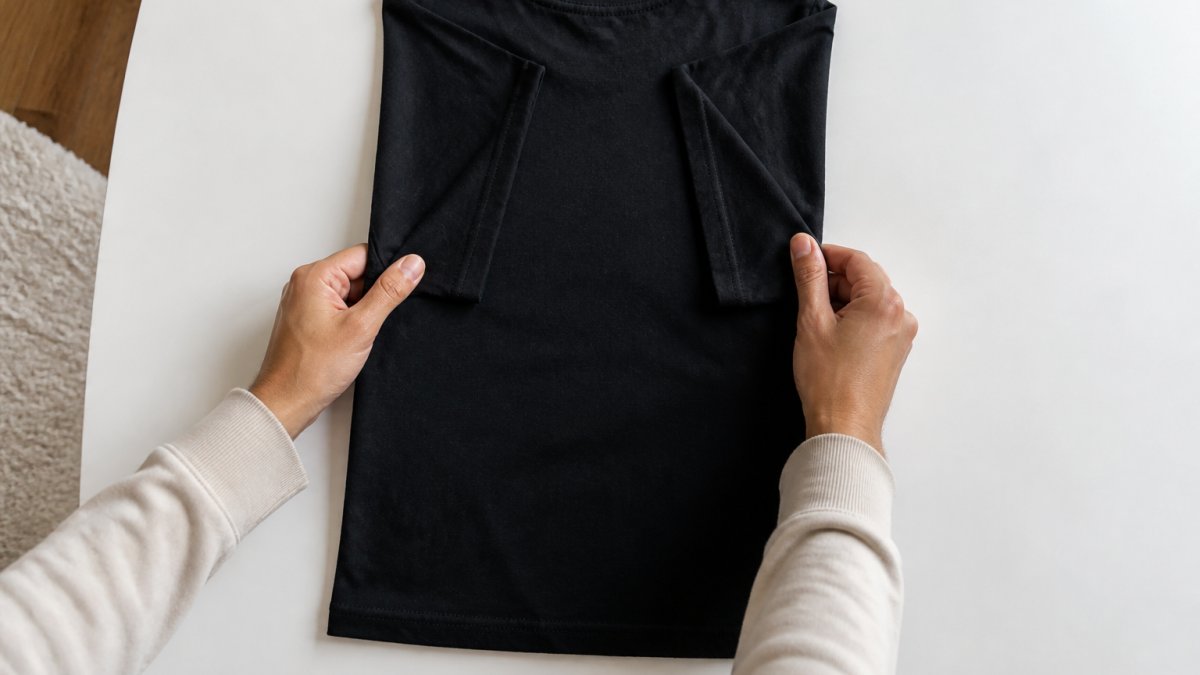
The Inside-Out Method for Print Protection
Turning the shirt inside out is the single best move for print longevity. It keeps the graphic away from other fabrics and from the fold itself.
Flip the tee inside out, then fold as normal. The print now faces inward, protected from friction. This is the same trick that keeps prints crisp in the wash, and it works just as well in a drawer.
The KonMari Fold for Drawer Storage
The KonMari method stands shirts upright instead of stacking them flat. That means no weight pressing down on the print.
Fold the tee into a neat rectangle, then fold it in thirds so it stands on its own. Line shirts up side by side in the drawer like files. You can see every design at a glance, and nothing gets crushed.
Hanging vs Folding Graphic Tees: Which One Saves Your Print?
For heavy graphic tees, folding wins. For lightweight ones you wear often, hanging is fine.
The trade-off comes down to two things: shoulder stretch and print stress.
| Method | Best For | Print Risk | Space Used |
|---|---|---|---|
| Folding | Heavy prints, long-term storage | Low | Low |
| Hanging | Lightweight tees in rotation | Medium | High |
| Inside-out folding | Any graphic tee | Lowest | Low |
Hanging a tee by the shoulders can stretch the neckline over time. Folding avoids that, but a bad fold can crease the print.

If you hang, use wide, padded hangers and never hang a wet tee.
How to Remove Creases from Graphic Tees Without Damaging the Print
A steamer is the safest way to remove creases from graphic tees. Heat and moisture relax the fibers without pressing directly on the ink.
Here's how to do it:
- Hang the tee on a hanger.
- Hold the steamer a few inches from the fabric.
- Work in slow passes, letting the steam do the work.
If you only have an iron, turn the shirt inside out and use the lowest heat setting. Press around the graphic, never on it. A pressing cloth adds another layer of safety.
The Best Way to Fold T-Shirts for Travel (Without Wrinkles)
The best way to fold t-shirts for travel is the roll-and-bundle method. Rolling prevents hard creases and saves space in your bag.
Start with the inside-out fold, then roll the shirt from the bottom up.
Undiagnosed But Something Ain't Right Unisex T-Shirt – Chronically Online →
For a concert or event, roll two or three tees together so they support each other. That keeps everything smooth and ready to wear.
Fabric-Specific Folding: Cotton Jersey vs. Blends vs. Vintage Prints
Most folding guides treat every graphic tee like it's the same 5.3 oz cotton jersey. It isn't. The fold that protects a heavy ring-spun cotton tee will set a permanent line in a tri-blend and can crack a heat-transfer print on a vintage shirt. Fabric weight, fiber content, and print method all change how you should fold.

Here's how to match your fold to the shirt.
Heavyweight Cotton (6 oz and up)
Heavy ring-spun and combed cotton has thick, lofty fibers that resist creasing but hold a fold once it sets. The risk isn't a sharp crease, it's a hard fold line that presses ink into the fabric over months of stacking.
- Fold along the side seams, not the center of the chest.
- Use a three-panel fold (sleeves in, then thirds) rather than a single half-fold. More panels mean softer angles.
- Store upright. A heavy tee at the bottom of a stack presses its fold into everything below it.
Midweight Cotton-Poly Blends (50/50 and 60/40)
Polyester adds memory. A blend that's folded the same way for a few weeks will hold that line even after washing. This is the fabric most likely to develop a visible crease across the graphic.
- Fold inside out so the print never sits on a fold line.
- Alternate fold direction each time you refold, front-fold one week, back-fold the next, so no single line becomes permanent.
- Skip the vacuum bag. Blends trap the crease and the compression locks it in.
Tri-Blends (Cotton/Poly/Rayon)
Tri-blends are soft, drapey, and prone to stretching rather than creasing. The bigger risk is distorting the neckline or shoulder shape during the fold.
- Support the shirt with both hands when you lift it, don't grab it by the shoulders.
- Fold in thirds, not halves. A half-fold on a tri-blend pulls the fabric off-grain.
- Store flat if you can. Upright filing works, but tri-blends slump and lose their shape in a tight drawer.
Vintage and Heat-Transfer Prints
This is where folding actually matters most. Heat-transfer and older screen prints sit on top of the fabric as a cured plastisol or transfer film. That film is brittle. A fold that crosses the print flexes the ink every time the shirt moves.
- Never fold across the graphic. Fold around it.
- Roll instead of fold when the print spans the full chest.
- Store flat in a single layer, or interleave with acid-free tissue if you must stack.
If you're not sure what you're working with, check the tag. Fiber content and weight are printed there, and they're the fastest way to pick the right fold.
Long-Term Storage Solutions for Graphic Tee Collections
A graphic tee that survives a year in a drawer can still be ruined in three months of bad storage. The enemies aren't just weight and fold lines, they're humidity, pests, acid migration, and light. Most folding guides stop at "store upright" and never address any of them.
Here's what actually preserves a collection.
Control Humidity First
Cotton and cotton blends absorb moisture from the air. Above roughly 60% relative humidity, that moisture feeds mildew and accelerates ink breakdown. Below about 40%, natural fibers dry out and become brittle, which makes prints more likely to crack when handled.
- Aim for a stable 45-55% relative humidity in the storage area.
- A simple hygrometer, the kind sold for cigar humidors, costs under $20 and tells you what you're actually dealing with.
- Avoid basements and garages. Temperature and humidity swings there are the fastest way to ruin a print.
Use the Right Materials
Ordinary cardboard boxes and tissue paper are acidic. Over months, that acid migrates into fabric and yellows both the cotton and the print.
- Acid-free tissue paper between stacked prints.
- Acid-free or archival-quality boxes for anything you consider collectible.
- Breathable cotton or muslin garment bags for hanging storage, not plastic.
Prevent Pests Without Chemicals
Moths and carpet beetles eat natural fibers, and they're drawn to the protein and starch residues left in fabric. Cedar and lavender are the traditional deterrents, but they lose potency as they age.
- Refresh cedar blocks or sachets every few months, or replace them.
- Keep stored tees clean. Body oils and food residue are what pests are actually after.
- Inspect seasonal storage every few months rather than once a year.
Manage Light and Rotation
UV light fades and yellows prints faster than almost anything else. A tee stored near a window can show visible fading in a single summer.
- Store in opaque boxes or drawers, not clear bins on open shelves.
- If you display tees, rotate them out of direct light every few weeks.
- Keep long-term storage in a cool, dark interior closet rather than an exterior wall.
The Rotation System
For a collection you actually wear, the practical setup is a two-tier system:
- Active rotation: Shallow drawer, upright folds, inside-out, refolded every few weeks.
- Long-term storage: Rolled, interleaved with acid-free tissue, laid flat in an archival box, in a cool dark space at stable humidity.
Label the boxes by season or category so you're not digging through them every time you want a specific print. Every time you handle a stored tee, you're adding wear, so handle it as little as possible.
A collection stored this way will outlast one stored in a stacked drawer by years, not months. The prints stay sharp, the fabric stays supple, and nothing sets into a permanent crease.
Frequently Asked Questions
Does folding graphic tees damage the print?
Folding itself does not damage the print, but folding the shirt so the graphic faces outward and rubs against other shirts in a drawer can cause friction that leads to cracking and peeling over time. The fix is simple: fold your graphic tees inside-out so the print stays protected, or fold with the graphic facing inward. Avoid folding directly along the printed area, since repeated creasing along the same line can stress the ink.
How to fold a tee shirt so it doesn't wrinkle?
Lay the shirt flat on a smooth surface and smooth out any existing wrinkles with your hands. Fold one sleeve across the back of the shirt, then the other, keeping the fold lines straight. Fold the shirt in half or thirds depending on your drawer depth. Store shirts vertically in a drawer or stack them loosely so the fabric is not compressed. Cotton jersey holds up well, but any shirt left in a tight stack for weeks will crease.
Is it better to roll or fold shirts when packing?
Rolling works better for travel because it eliminates hard fold lines and lets you pack shirts tightly without stacking weight on top of them. For graphic tees, roll the shirt inside-out so the print stays on the inside of the roll. Start from the bottom hem and roll upward toward the collar. This keeps the graphic from rubbing against other items in your bag and reduces the chance of creases forming during transit.
How to store t-shirts so they don't crease?
File-fold your shirts vertically in a drawer instead of stacking them flat. Vertical storage means each shirt stands on its edge, so nothing presses down on the fabric. If you hang instead, use a broad hanger that supports the shoulders and avoid wire hangers that stretch the collar. Keep shirts out of direct sunlight and away from damp areas. Rotate your collection so the same shirts are not compressed at the bottom of a pile for months.
Your graphic tees deserve better than a crumpled pile at the bottom of a drawer. At Hot Takes Designs, every piece is custom-printed, cut, and sewn to order on ultra-soft fabrics with vibrant, long-lasting prints. Fold them right and those designs stay sharp for every concert, photo dump, and main character moment. Get started with Hot Takes Designs and keep your prints looking as bold as the day they arrived.