

Best Laundry Detergent for Vibrant T-Shirt Colors
Table of Contents
- Why Your Favorite Graphic Tees Fade (And How Detergent Plays a Role)
- What to Look For: The Best Detergent for Colored Clothes
- How to Wash Graphic Tees Without Cracking the Print
- How to Prevent Clothes From Fading: Temperature, Water, and Timing
- The Best Laundry Detergent for Preserving Vibrant T-Shirt Colors: Top Contenders
- Common Mistakes That Ruin Colors (And What to Do Instead)
- Conclusion: Keep Your Colors Loud and Your Prints Intact
- Frequently Asked Questions
Last Updated: October 6, 2026
Why Your Favorite Graphic Tees Fade (And How Detergent Plays a Role)
The best laundry detergent for preserving vibrant t-shirt colors is a mild, liquid, enzyme-light formula that cleans without stripping dye or cracking screen prints.
Your detergent is often the villain. According to the American Cleaning Institute's guide to laundry basics, using the right amount of a gentle detergent matters as much as the detergent itself, since excess detergent leaves residue that dulls fabric over time.
What to Look For: The Best Detergent for Colored Clothes
The best detergent for colored clothes is a liquid labeled "free and clear" or "for colors," with no bleach, no optical brighteners, and a low dose of enzymes. Those three traits protect dye and prints at once. Here is what each ingredient class does to a dyed cotton tee.
The Ingredient Classes That Matter for Dye and Prints
Surfactants (the actual cleaners). These lift oils and dirt off fiber.
Enzymes (the targeted cleaners). Enzymes are proteins that break down specific soils. The four most common:
- Protease breaks down protein stains (grass, food, sweat). Generally dye-safe at normal wash concentrations.
- Amylase breaks down starches. Also generally dye-safe.
- Lipase breaks down fats and oils. Generally dye-safe.
Optical brighteners (the color fakers). These fluorescent dyes absorb ultraviolet light and re-emit it as visible blue light. They do not clean anything.
Bleach and bleach activators. Any bleach, chlorine or oxygen, oxidizes color.
Builders and pH adjusters. Powders often rely on builders like sodium carbonate that push wash water alkaline.
Reading the Label: A Practical Checklist
- "For colors" or "color-safe" on the front, a hint, not a guarantee. There is no regulated definition of "color-safe" detergent.
- "Free and clear" or "free of dyes and perfumes", your best shorthand for a formula without optical brighteners or added dye.
- No bleach listed anywhere in the ingredients or as a separate additive.
- No optical brighteners, check the ingredient panel, not the marketing copy.
Ingredients That Protect Dyes vs. Ingredients That Strip Them
Ingredients that protect dye are mild surfactants and chelating agents, which lift dirt and hold hard-water minerals in suspension so they rinse away. Ingredients that strip dye are bleach, optical brighteners, and high concentrations of cellulase:
- Cellulase eats tiny fiber fuzz. On cotton, that fuzz scatters light and makes color look bright. Strip it away and the shirt looks older faster.
- Bleach, even "color-safe" oxygen bleach in large doses, oxidizes dye over repeated washes.
- Optical brighteners do not clean anything. They sit on fabric and reflect blue light, making whites pop but colored prints look hazy.
- Excess detergent never rinses out fully. The leftover film traps dirt and dulls color.
Liquid vs. Powder: Which Is Safer for Prints?
Liquid detergent is safer for prints and colors than powder. Powder formulas can leave undissolved granules that abrade screen print ink, and many rely on builders that raise wash pH, which is harder on dye. For a printed T-shirt, liquid wins: it rinses cleaner and is gentler on the adhesive layer holding the screen print to the fabric.
How to Wash Graphic Tees Without Cracking the Print
The right wash cycle for graphic tees is cold water, a gentle or delicate cycle, and low spin, protecting both the dye in the fabric and the ink on top of it.
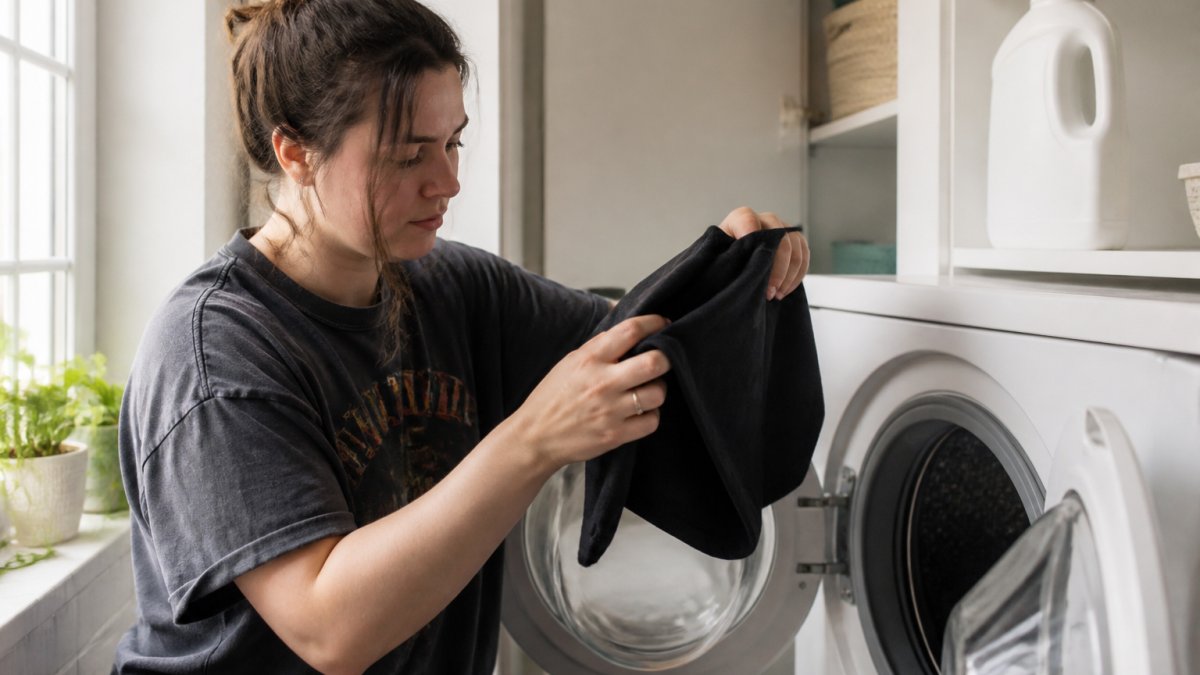
Cracking almost always starts at the print's edges, where ink meets fabric. Heat and friction pull that edge loose, then it spreads. Cold water and a short, gentle cycle slow that process dramatically.
Step-by-Step: The Wash Cycle That Saves Your Shirt
Follow this sequence every time you wash a printed tee:
- Turn the shirt inside out. This puts the print against itself, not the drum or other clothes.
- Set the machine to cold water. Cold protects dye and prevents print adhesive from softening.
- Choose a gentle or delicate cycle with low spin.
- Add mild liquid detergent to the dispenser, not directly on the fabric. Use less than the cap suggests for a small load.
- Skip fabric softener and dryer sheets on printed shirts. Both leave a coating that dulls color and weakens print adhesion.
- Air dry or tumble on low. High heat is the fastest way to crack a print.
- Hang or lay flat to finish drying, away from direct sun.
If you are short on time, the two steps that matter most are cold water and inside-out. Everything else is a bonus.
How to Prevent Clothes From Fading: Temperature, Water, and Timing
To prevent clothes from fading, wash in cold water, keep cycles short, and avoid overloading the drum.
Temperature is the biggest lever. Hot water opens fabric fibers and lets dye escape; cold water keeps them closed.
Water quality matters too. In hard-water areas, minerals bind to detergent and leave residue that dulls color; a chelating detergent or water softener helps.
The Best Laundry Detergent for Preserving Vibrant T-Shirt Colors: Top Contenders
The best laundry detergent for preserving vibrant t-shirt colors falls into a few clear categories, and which one wins depends on your water, your fabric, and how much you care about a specific print. Here is how the categories were evaluated, what each costs per load, and which fits which shirt.
How These Categories Were Evaluated
Because no single published lab test covers every detergent on the shelf, this comparison is built from three inputs: (1) each product's ingredient panel, read against the dye-and-print mechanisms above; (2) the manufacturer's dosing and wash-temperature guidance; and (3) common patterns reported by home launderers and garment-care practitioners who wash printed tees repeatedly.
A transparent test you can run at home: take two identical dark cotton tees, wash one 20 times in a free-and-clear liquid on cold/gentle and the other 20 times in a standard color-protect liquid on warm/normal, then compare them side by side in daylight.
The Categories, Compared
| Detergent Type | Best For | Key Strength | Main Trade-Off |
|---|---|---|---|
| Free & clear liquid | Sensitive skin, all colors | No dyes, no optical brighteners | Lighter cleaning power on heavy soil |
| Color-protect liquid | Everyday colored tees | Dye-transfer inhibitors, dye-locking polymers | Often still contains optical brighteners |
| Plant-based liquid | Prints and delicates | Mild surfactants, neutral pH | Higher cost per load |
| Concentrated liquid | Small, frequent loads | Less packaging, precise dose | Easy to over-pour and over-dose |
| Powder | Whites and towels | Strong cleaning, low cost per load | Can abrade prints, higher wash pH |
For most printed tees, a free-and-clear or plant-based liquid is the safest bet. It skips the brighteners that haze dark dyes and the aggressive builders that raise pH.
Cost Per Load: The Math Most Guides Skip
Cost per load, not cost per bottle, is the number that matters. Divide the bottle price by the number of full-dose loads the bottle claims, then adjust for how much you actually use. A concentrated formula that costs more per ounce but doses at half the volume can land at a similar or lower cost per load than a standard bottle.
Two practical rules:
- Concentration changes the math. A 2x or 3x concentrated liquid uses less per load, so compare price per load, not price per fluid ounce.
- Small loads need less detergent. For a small load of tees, half the recommended dose is common practice and stretches the bottle further, provided the shirts are not heavily soiled.
Match the Detergent to the Shirt
Not every tee wants the same formula. Segment by material and print type:
- 100% cotton, screen-printed. Free-and-clear or plant-based liquid, cold water, gentle cycle. Avoid cellulase-heavy formulas so the fiber stays thick enough to hold dye.
- Cotton/poly blends. Blends hold dye differently than pure cotton; a color-protect liquid with dye-transfer inhibitors helps when you wash mixed colors together. Keep the temperature cold.
- Performance and synthetic fabrics. Typically dyed with disperse dyes sensitive to heat and oily soils. Use a mild liquid, cold water, and skip fabric softener, which can clog the wicking structure.
- DTG and DTF prints. These sit on top of the fabric with a softer hand than screen print. Gentle cycle, inside out, low spin, no direct detergent contact.
What Most Guides Miss
"Color-safe" on a label is a marketing claim, not a regulated standard. Read the ingredient list instead of trusting the front of the bottle. And remember that detergent is only one variable, water temperature, cycle length, load size, and drying method all move the needle. A great detergent on a hot, heavy cycle will lose to a decent detergent on a cold, gentle cycle almost every time.
Common Mistakes That Ruin Colors (And What to Do Instead)
The mistakes that ruin color are almost all about too much of something: too much detergent, heat, agitation, or time. Fix the excess and your colors last far longer.
- Overdosing detergent. Extra soap does not clean better; it leaves residue that traps dirt and dulls dye. Use half a cap for a small load.
- Washing in hot water. Heat is the number one cause of fading. Switch to cold.
- Using fabric softener on prints. It coats the ink and weakens adhesion. Skip it.
- Drying on high heat. This cracks prints faster than anything else. Air dry when you can.
Conclusion: Keep Your Colors Loud and Your Prints Intact
Nobody wants their favorite graphic tee to look tired after five washes. Color retention comes down to a few controllable choices: a mild liquid detergent, cold water, a gentle cycle, and no heat in the dryer.
At Hot Takes Designs, every piece is custom-printed, cut, and sewn to order using ultra-soft fabrics and vibrant, long-lasting prints. Our tees are built to survive real laundry routines, not just the first wear.
Frequently Asked Questions
What is the best detergent for keeping colored clothes bright?
Look for a mild liquid detergent labeled for colors, free of bleach and optical brighteners. These formulas clean without stripping dye. Avoid detergents with cellulase enzymes, which break down cotton fibers and can dull prints over time. A gentle, color-safe detergent used in cold water keeps vibrant t-shirt colors from fading wash after wash.
Which laundry detergent is safest for graphic T-shirts?
Liquid detergents without bleach or harsh chemicals are safest for printed T-shirts. They dissolve fully in cold water and leave less residue that can crack screen prints or dull tie-dye. Powder detergents sometimes leave undissolved granules that abrasively wear down fabric prints. Always check the label for 'color-safe' or 'gentle on fabrics' and skip anything with chlorine bleach.
Should you use liquid or powder detergent for colored clothes?
Liquid detergent is generally better for colored clothing because it dissolves completely, even in cold water, and rinses clean without leaving residue that attracts dirt or dulls dyes. Powder formulas can work well in warm water but may not fully dissolve in cold cycles, leaving particles that rub against fabric prints. For best results with graphic tees, choose a concentrated liquid made for colors.
How do you wash T-shirts without fading the colors?
Turn shirts inside out, wash in cold water on a gentle cycle with a mild color-safe detergent, and skip the dryer. Heat is the main enemy of dye and print longevity. If you must dry, use the lowest heat setting or air-dry flat. Also avoid overloading the machine, which causes friction that wears down prints and fades fabric.
Your favorite tee deserves a wash routine that respects the print, not one that slowly erases it. Hot Takes Designs makes custom-printed apparel with vibrant, long-lasting prints and ultra-soft fabrics, so the shirt you love stays loud. Browse the collection and find your next main character piece with confidence.